
Bend Sinister
How Are So Many Southpaws Thriving Despite Dubious Stuff?


It’s hard out there for lefties in a righty-dominated world. Learning to write is a trauma of bleeding lines and inky fingers, doors swing open to the right side, and playing shortstop (or taxing billionaires) is strictly verboten.
Of course for baseball pitchers it’s different. Southpaw tossers have always been prized precisely because lefties are rare and, well, weird.
This season especially we are seeing myriad left-handed starting pitchers succeed despite lacking star power, great velocity, or nasty stuff. Driven by outlier results from pitchers projected as middle class at best, southpaw starters as a whole are posting significantly better numbers, on average, than their super-majority righty counterparts.
Matthew Boyd may be their patron saint, but others in this mold like Kris Bubic, Andrew Abbott, and even relative unknowns like Brandon Walter have outperformed the expectations of pitching models, projection systems, and maybe even their own teams.
Are they pulling off magic tricks (ILLUSIONS, Michael) or is something more nefarious at hand? After all, “sinister” is the Latin root of “left” for direction—and handedness.
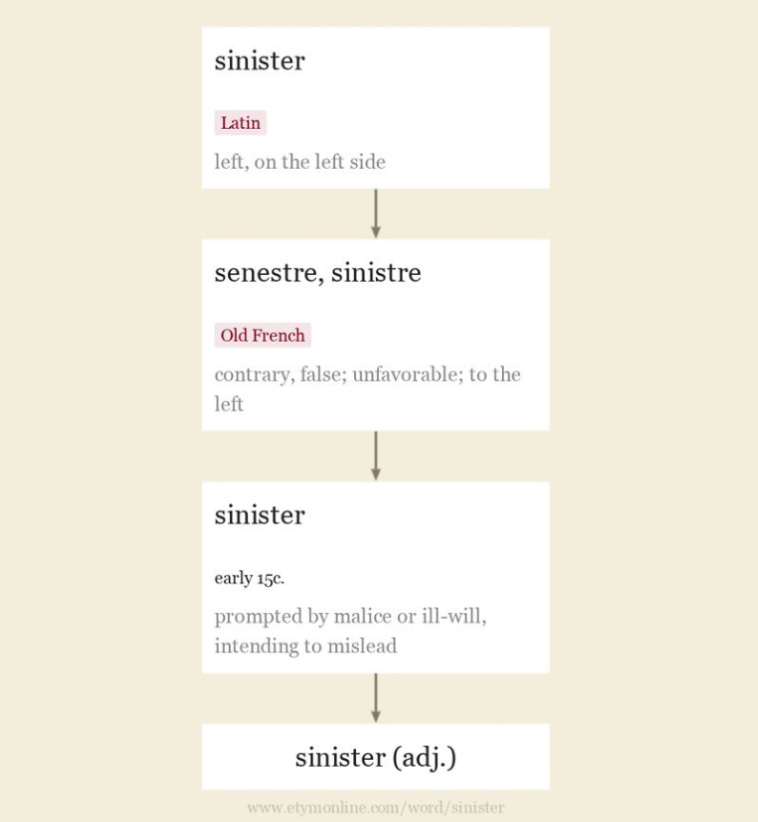
While the Latin sinister began as a directional term—in opposition to dexter for right, which eventually gave us dexterity and dexterous—over time “sinister” took on the dark, ominous meaning it has long held in modern English (studying the words’ origins opens a world of etymological scholarship concerning Greco-Roman omens, early Christian texts, and representations of bastards in feudal heraldry).
Similarly, the Old English “riht”—from Old German—meant both “correct” and “straight.” Heck, Jesus implied that even God is right-handed (or at least that, as co-equal, the son would sit to the father’s right hand) (Matthew 26:64).
Meanwhile, the Old English progenitor of our left, “lyft,” described direction but also “weakness or uselessness.” Another example of the tyranny of the artless majority.
Fans and fantasy owners of the Boyd-Bubic-Abbott axis (the BoBuBotts?) would vigorously argue there is nothing useless about them; on the contrary, those three southpaws rank third, seventh and ninth in ERA among all major league starters (min. 100 IP). Bubic and Boyd rate top 15 in fWAR, while Abbott—who missed his first four starts of the season rehabbing an injury—sits 24th, just ahead of another crafty lefty in David Peterson.
As for Walter, once he became a full-time starter at the beginning of June, while healthy he ranked among the elites with a 22.7% K-BB% (8th best), 0.95 WHIP (9th), and 3.11 SIERA (11th). (Unfortunately, as I researched this, both Walter and Bubic landed on the IL with elbow inflammation and rotator cuff strains, respectively).
However, while they clearly are not useless, one could fairly accuse the BoBuBotts of satisfying the “weakness” root of left. Each of their fastballs sits between 91 and 93.1 mph, lagging well below the 94.1 mph major league mean in fastball velocity. Other lefties like Peterson, Noah Cameron, Jacob Lopez and Ranger Suarez also fit this low-velo, outlier-success mold.
This is not surprising. For as long as we’ve had reliable pitch data, lefty pitchers have generally had lower average velocity than righties (Aroldis Chapman being the cyborg that proves the rule).
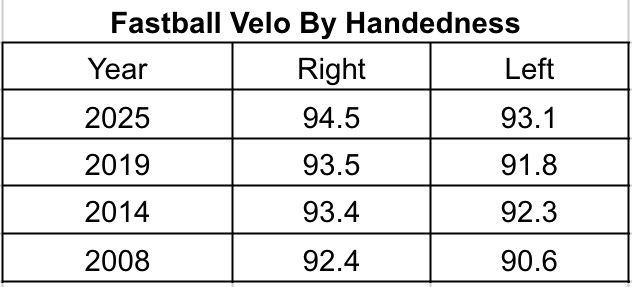
For example, all right-handed starter fastballs average 94.5 mph this season, while lefties clock in at 93.1. Going back to 2019, it was 93.5 for righties versus 91.8 for southpaws.
The split was even more extreme in 2008, when modern pitch tracking began: 92.4 mph for righties and 90.6 for those feckless, damnable lefties.
Of course we’ve long had lefty aces who don’t throw gas. But Framber Valdez and Max Fried, for example, do average around 95 mph, feature outlier ground ball skills, and sport two of the best curveballs in the game. Their excellence is self-evident.
The BoBubott crew begins with entirely different and seemingly ridiculous first principles: we are going to throw slowly and induce fly balls instead of grounders—and still avoid damage.
This should be impossible, or at least difficult, to pull off. So how are they doing it?
Scarcity—Or, Lefties Are Weird
There are a few ways that being in the handedness minority helps pitchers, and one of them is a simple numbers game. We recently heard Trevor Plouffe mention how difficult it is facing a lefty like Cristopher Sanchez because he presents a look that batters rarely see (Baseball Today pod, ep. 783). Sanchez has outlier size at 6’6” but the rarity concept holds true for lefties generally.
There are currently 40 right-handed starters who qualify for the ERA title. There are just 16 such lefties, making them 29% of the total qualified starter population.
Of course that number may be skewed by random health outcomes. But if we lower the playing time threshold to 60 starter innings, we see that hitters face an even greater preponderance of righties. That pool consists of 146 starters, only 37 of which are southpaws. That’s 25.5%.
Last year the ratios were similar for the entire season, with 42 lefties among the 163 starters who reached at least 60 IP (25.8%). It was 27.3% in 2023 and 27.8% in 2019. (Among relievers, southpaws have held at around 27% over the last three seasons).
So the proportion of lefty starters is a little over one-fourth of the league. If anything, batters are seeing pitchers from the left side even less now compared to just two seasons ago.
Another rarity factor is that lefties are more likely than righties to throw from a funky, generally lower, arm slot. A 37 degree arm angle is roughly median for both sides, but 42% of lefties throw from a sub-35° angle compared to 38% of righties who do so. Against lefties a batter often has to adjust his visual cues not just to the handedness, but also to the tunnel the pitcher’s arm angle creates.
Angles don’t fully explain our quartet. Boyd and Walter have fairly funky 28° and 27° arm angles, but Bubic’s 38° is about league median, and Abbott at 48° has one of the more over-the-top deliveries. Jacob Lopez, however, really exemplifies lefty strangeness: his 21° angle is practically sidearm and he extends 7’2” down the mound (95th percentile).
Taking a 30,000-foot view, here is how starting pitchers are performing this season, by handedness:
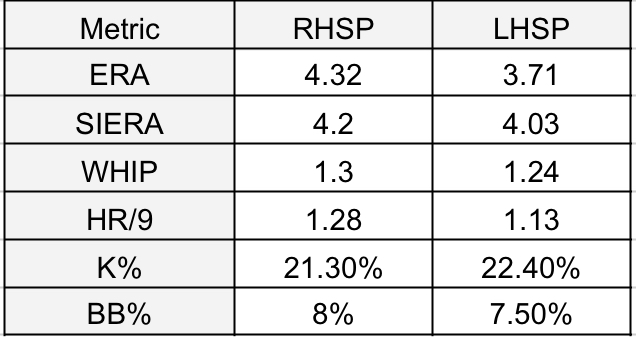
Despite fairly similar strikeout, walk, and home run rates, the right-handers’ runs allowed results are notably worse, and fall pretty much in line with their skills-based ERA estimators like SIERA and FIP (4.29). The southpaws, on the other hand (yikes, unintentional pun), are beating the results that their estimated skills might describe (3.90 FIP).
It sure seems like simply being left-handed provides an advantage (at least for baseball pitching). There are a few other shared, specific factors driving the success of the low-velo, middling stuff quartet of Boyd, Bubic, Abbott, and Walter.
Command And Control
Humans are obsessed with traits and skills we can measure. Once we achieve some new level of efficiency, we rarely stop there, content to distribute the gains from the newfound approach or invention equally among the many, particularly where money is concerned (one of many reasons Keynes’ prediction of a 15-hour work week by 2030 seems more absurd now than it did in 1930).
Money motivates sports teams and players too, and chasing velocity and extreme spin is a natural consequence of having finer and more accurate means of measurement. Recall that earlier velocity chart: average fastball velo has increased as much in the past five years as it did in the prior 11. Back in 2009 only 6% of four seam fastballs were thrown at 97+; now it’s 17%.
What happened in-between? Statcast and its fancy tracking cameras were introduced in 2015. Suddenly we could measure everything in minute detail, which led to an actual, accelerated arms race. (It is probably no coincidence that external training facilities like DriveLine and Tread were either founded or only gained wider recognition post-Statcast.)
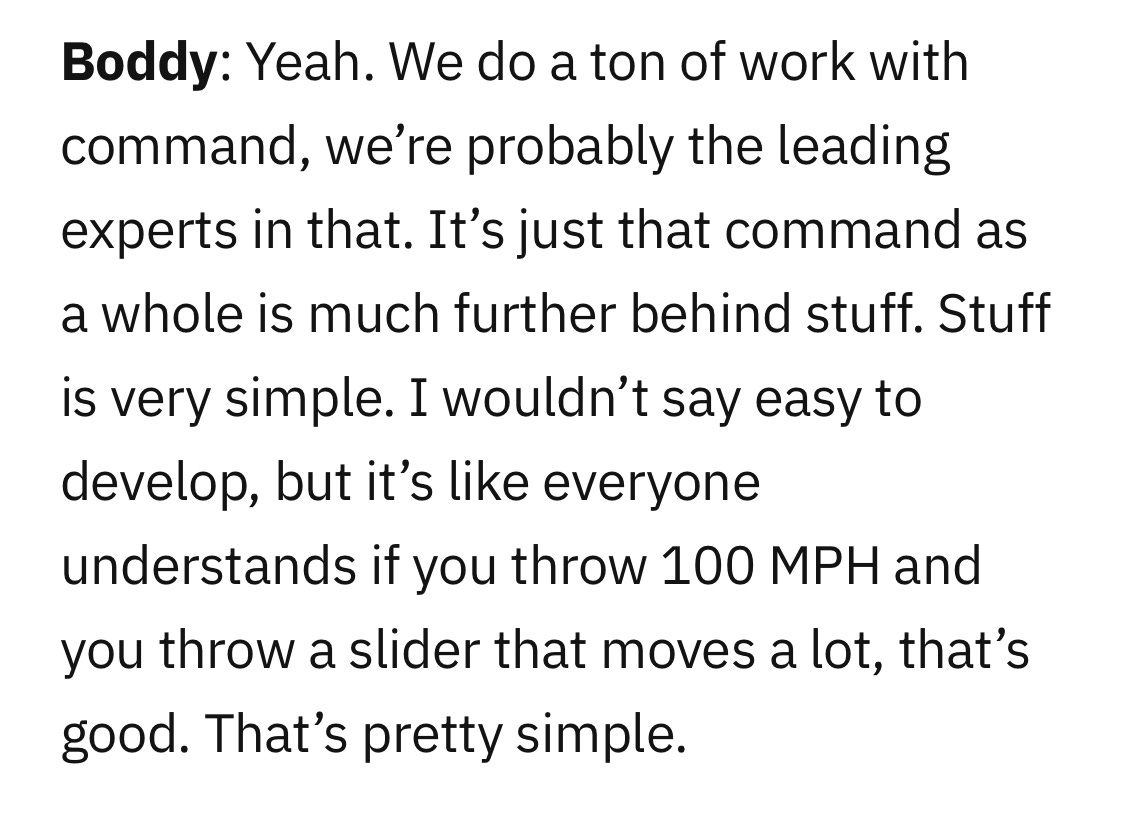
Everything, that is, except command. This squishy skill will be the next marginal efficiency to exploit. Which isn’t to say location can’t be measured—we now know with greater certainty where pitches perform best in and around the zone—but teaching a young hurler how to consistently hit those spots is not nearly as straightforward as training for increased velocity and spin efficiency.
Kyle Boddy, founder of DriveLine Baseball, discussed this general difficulty in an interview with SB Nation this past March:
(Full interview: https://www.athleticsnation.com/2025/3/18/24388281/driveline-chat-kyle-boddy-interview-part-i-of-iii-kyle-boddy-travis-bazzana-mason-miller)
Hell, one approach that has gripped the baseball zeitgeist is to have pitchers aim for the dead center of the zone and let their pitches’ natural movement take over. Even Tarik Skubal, who leads qualified starters with a 3.8% walk rate and throws as many strikes as anyone (29.5% ball rate), recently said during an ESPN broadcast that the ball goes exactly where he wants it “20 percent of the time.”
Is our BoBuBott group way ahead of the pack in this area, at the vanguard of some new wave? Maybe not quite that—they have low-ish but hardly infinitesimal walk rates—but they all rely on plus command to make the most of questionable stuff. Here is how FanGraphs’ Stuff+ model grades their overall arsenals:
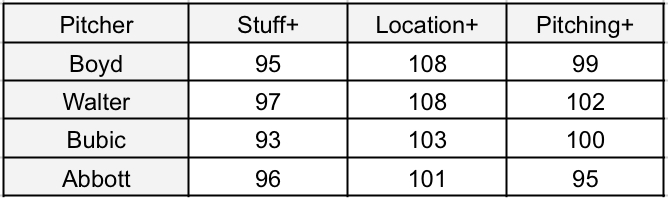
Stuff+ measures pitch quality based on velocity, movement and spin, among other factors. There is another model for command (Location+). A third model (Pitching+) combines elements of both, but is not merely a sum of the other two (that would be way too simple). The models are all pegged to 100 as average, with every 10 points in either direction representing one standard deviation.
The only individual pitches our quartet throws that rated above 100: Boyd’s slider (113) and Abbott’s slider (117). An average slider in Stuff+ terms actually rates as 110, so even these pitches are only slightly above average in stuffist terms.
No, it’s command where these guys really stand out. Boyd’s Location+ ranks top 10 among qualifiers (58 pitchers). Bubic ranks top 25. If Walter qualified, he’d be tied with Boyd, right there among the best command artists by this metric. Abbott’s number has slipped a bit recently, but he was right there with Bubic at the end of July.
In more traditional control terms, they have largely limited free passes. The league average starter walk rate is 7.9%. Bubic is slightly over this line, Abbott is just below, and Boyd and Walter—especially Walter—excel with walk rates of 5.4% and 1.9%, respectively.
Bubic’s 8.2% walk rate may be inflated by his intentions. He actually throws an above-average number of strikes overall (33% ball rate). One explanation for the middling walk rate is that in 3-2 counts, he walks batters 33% of the time. That’s 7.5% worse than Abbott and 15% higher than Walter, who throws the most strikes in full counts (18.2% walk rate). Bubic, however, also has a 35% strikeout rate in such counts, the highest of the quartet. It appears that he is more willing to go for the punch out, leading to more whiffs—but also the occasional walk.
Of course, avoiding walks is not the only benefit of great command; a good control pitcher throws enough strikes for that. To go back to that DriveLine concept of intent, the BoBuBotts may be racking up whiffs and avoiding damage because of where they put the ball.
Whiffs & Weak Contact Living On The Edge
All of Boyd, Bubic, Abbott and Walter have minimized hard contact, especially on their fastballs (Boyd’s four seamer allows a higher average exit velocity than his compatriots’ but the actual .372 slugging against is plus). And most of them—excluding Walter—also avoid home runs despite batted ball profiles that lead to more fly balls and line drives than average.
Here’s a comparison of contact quality allowed on four seamers, grouped by all pitchers, all left-handers, and the BoBuBotts:
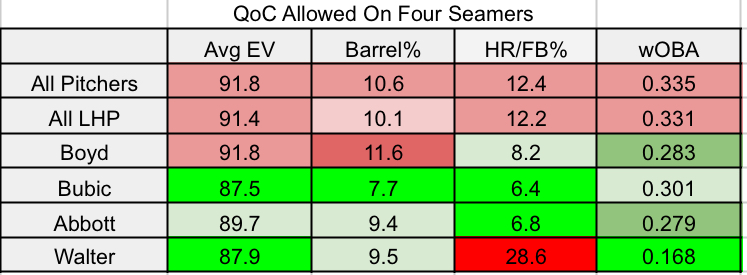
Look at the home run per fly ball rates and recall that none of our heroes throws heaters harder than 93.3 mph.
Fly balls turn into homers 13% of the time for the league as a whole on all pitches. The rate is over 12% on four seamers for the league and for lefties in general, which is basically double what Bubic and Abbott allow. Boyd’s rate is a scooch higher than theirs but the league is still 50% worse. Walter’s four seamer has an elevated rate, which is likely a small sample outlier given the excellent 87.9 average exit velocity he allowed on it.
Now, as we noted, these pitchers put the ball in the air a good amount so one might ask whether their overall home run rate is high even if the rate of fly balls to homers is low. Nope. Boyd and Bubic allow less than .8 HR per 9, while Abbott at 1.01 HR/9 is still well below the 1.24 major league average. Walter’s 1.68 is inflated, again likely a small sample issue given he never exceeded 1.08 HR/9 in the minors.
Meanwhile, the conventional wisdom regarding fastball swing-and-miss and velocity is generally true: four seamers thrown 99+ mph have a 30%+ whiff rate, and it declines as we go down the velocity band to 19% for the 91-93 mph range. That’s where the BoBuBotts live but other than Boyd at 15.8%, all of Walter (31%), Bubic (27%), and Abbott (20.5%) beat the league averages for fastball whiff rate.
As to how they’re overperforming whiffs and avoiding home runs despite low velo and ground ball rates, there appears to be a specific location attack at play.
Lefties generally struggle most versus right-handed hitters and opposing teams stack their lineups to exploit this platoon advantage more and more every season.
The answer for our quartet is to locate their fastballs along the outer edge of the plate versus righties, a la Abbott:
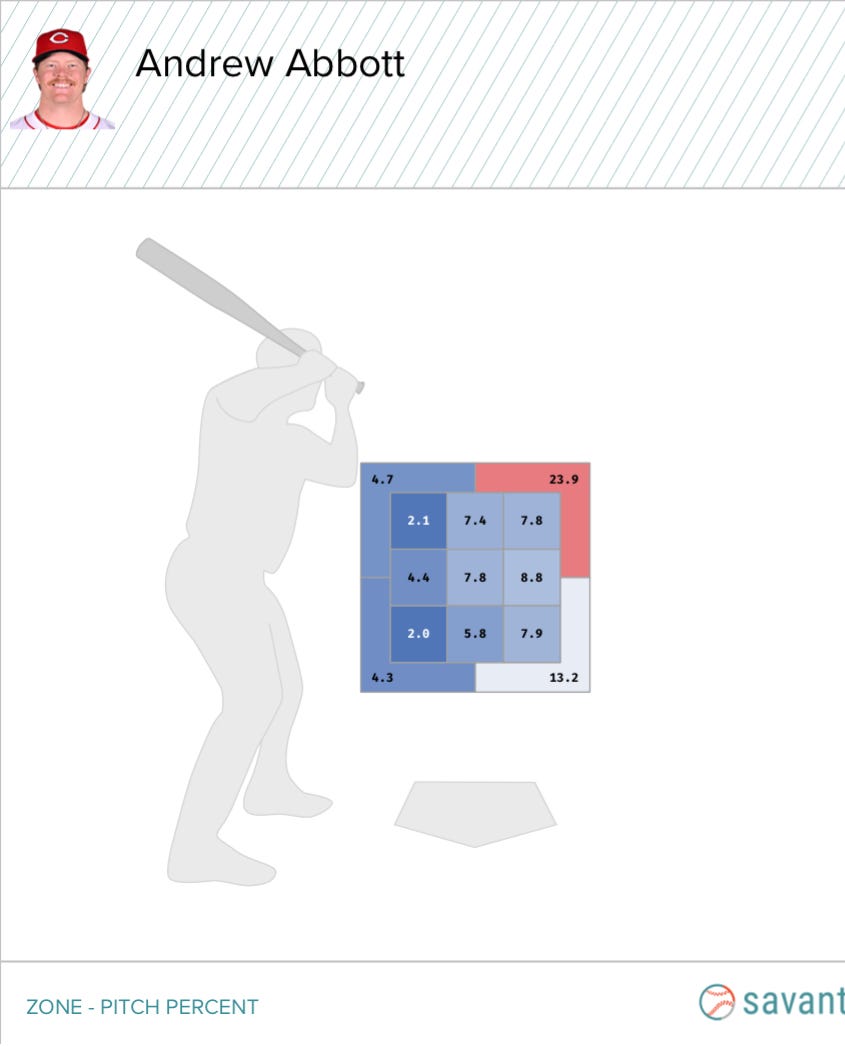
Abbott keeps his 92.5 mph fastballs safely away and usually up, leading to poor contact and whiffs. Righties are batting .192 and slugging .308 versus Abbott’s four seamer, both elite marks compared to right-handers’ .249 and .423 numbers against all lefty four seamers league-wide.
Abbott’s fastball also misses the most bats when up and around the outer edge of the zone:
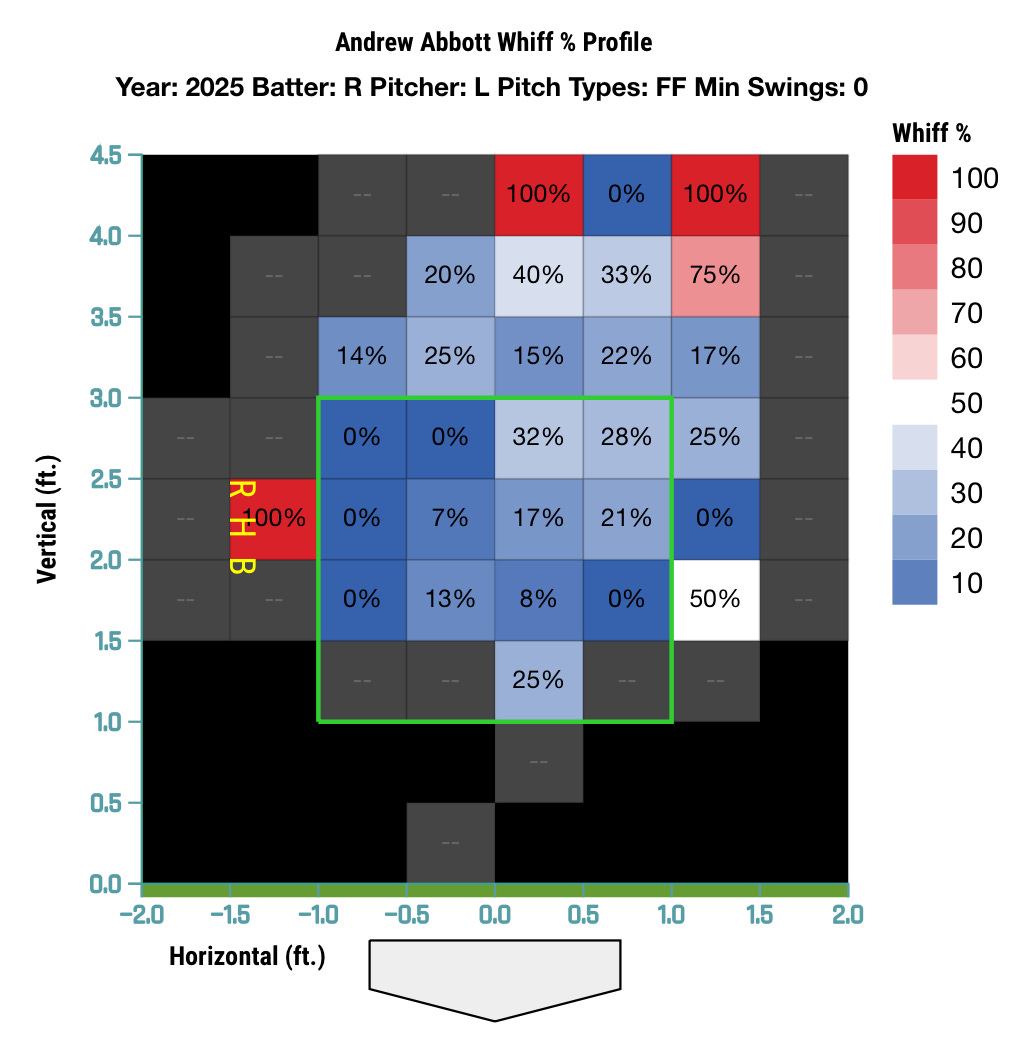
Executing these locations is how you earn a +13 run value (94th percentile) on a 92.5 mph four seamer with a 90 Stuff+ grade.
Meanwhile, righties are batting .187 and slugging .317 versus Abbott’s changeup, which he also focuses on the outer edge, but down. His changeup holds a +5 run value, which ranks 95th percentile.
Here are Abbott’s combined four seamer plus changeups locations against righties, by percentage of pitches thrown:
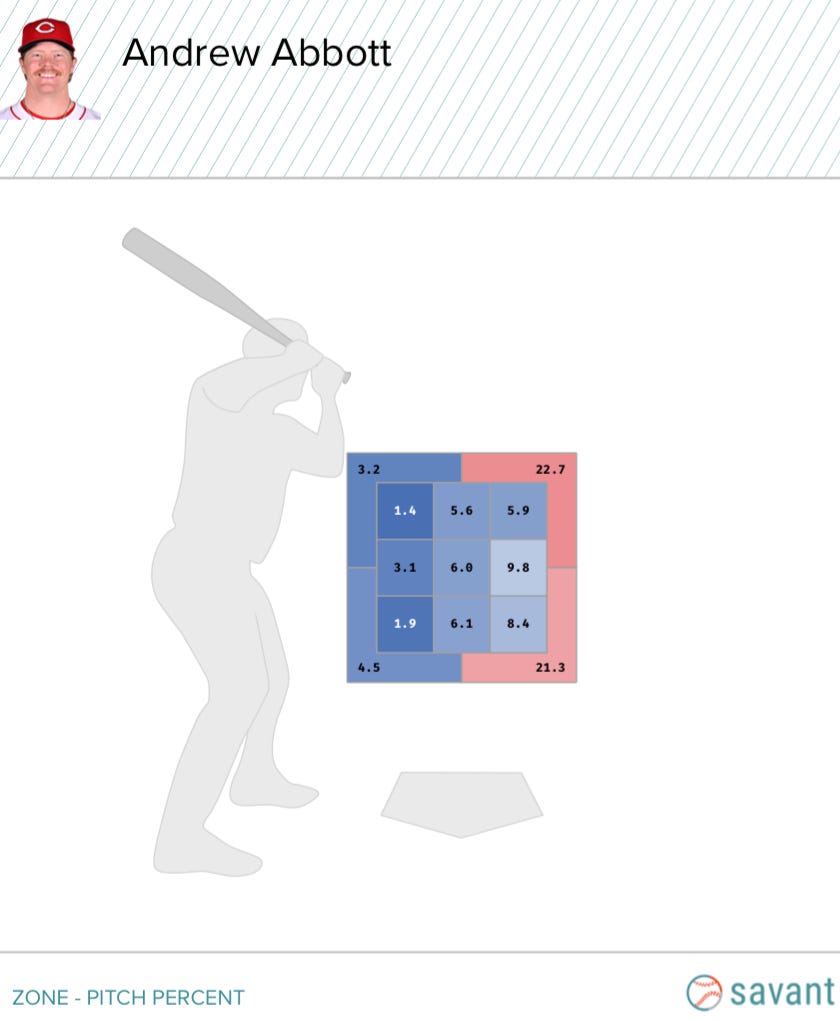
He throws four seamers and changeups 71% of the time to righties for a combined .190 average. Bubic and Walter take roughly similar approaches, with similar results.
Boyd is the least extreme “edge case” of this group in that he will challenge righties up-middle or up-in occasionally with his fastball. But even he generally concentrates four seamers and changeups away from righties:
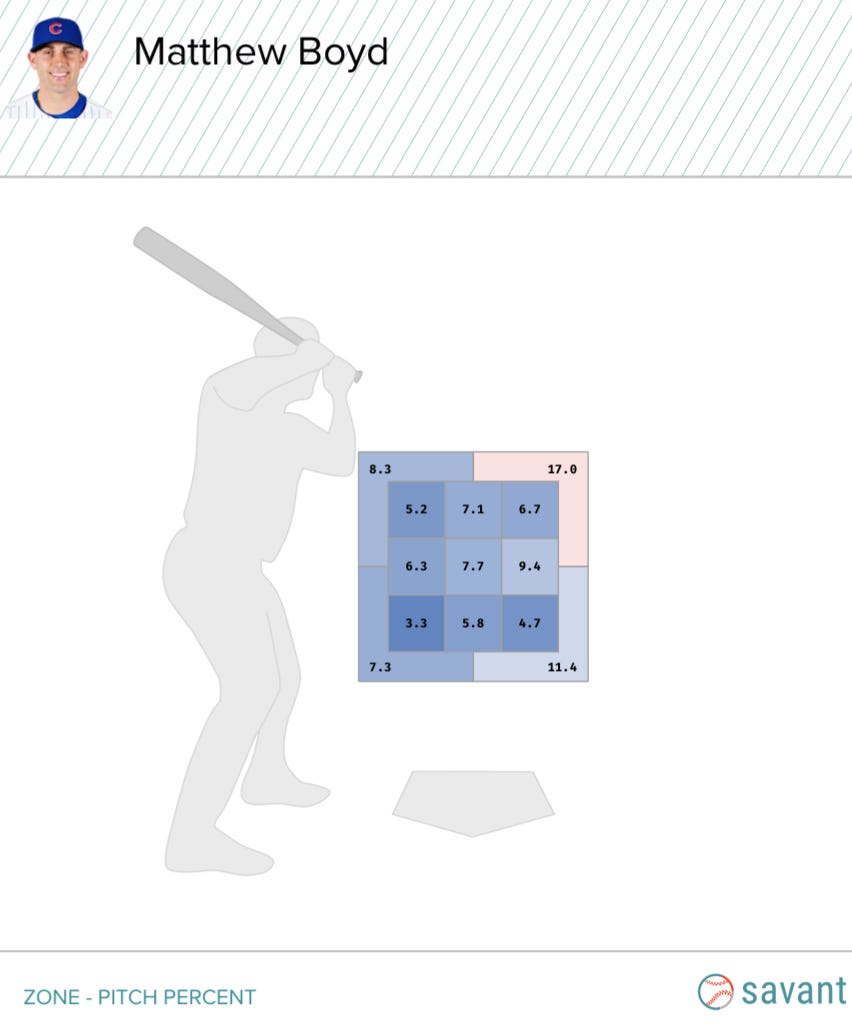
It’s difficult for right-handed hitters to get out in front and pull pitches that are well-spotted away. This is especially problematic against the BoBuBotts, who also happen to throw a lot of strikes—batters can quickly get behind in counts and have to protect the outer edge of the zone, leading to poor contact even when they manage to put the ball in play.
We are seeing other “useless,” low-velo lefties like Suarez, Peterson, Jacob Lopez and Noah Cameron similarly succeed by teasing the outer edge of the plate against righties.
Pulling off this specific location attack, while maintaining low walk rates, may be the key driver of success for all of these lefty breakouts.
Multiple Pitches and Killer Changeups
The rise of data and special training facilities has led teams and pitchers to aggressively pursue wider arsenals. We’ve had “the year of the sweeper,” then TYOT sinker, then TYOT cutter. Chase the popular fad and you can’t help but end up with multiple pitches. Recent seasons have seen the resuscitation of sinkers and multiple fastballs specifically.
Each of the BoBuBotts throws four pitches at least 10% of the time. Batters cannot sit on one pitch because they get at least three different kinds of movement and velocity, depending on handedness.
We mentioned the BoBuBotts’ changeup locations above. For a lefty, the changeup has always been the great equalizer against the great right-handed horde, which comprises two-thirds of the hitting cohort. Only a select group of left-handed bats—the Ohtanis and Sotos and the occasional Riley Greene—are allowed to face same-side arms every game. Hence cambios are at least as important to lefty slingers as sliders are for righties.
Each of our heroes possesses killer changeups. Boyd, Abbott and Bubic rank top 20 in terms of run value on the pitch (+6, +5, +2). Boyd and Bubic garner tons of whiffs on it (32% and 38%), while Abbott, like the others, simply induces terrible outcomes for hitters (.196 BAA, .333 SLG). Due to lower volume, Walter’s changeup has a neutral run value of 0, but flashed both elite swing-and-miss (40% whiff) and contact suppression marks (.202 xwOBA, 82.7 EV).
We all know about the elite Tarik Skubal and Cristofer Sanchez changeups. But it’s also a deadly weapon for these less heralded, surprise southpaw standouts.
Conclusion
They don’t have great or even good velocity. They don’t break stuff models. They don’t have amazing IVB or great extension or really any of the buzzy pitch characteristics we’re all told are essential to success.
No, appropriate to their evil, weak, no-good handedness, Boyd, Bubic, Abbott and Walter succeed in unusual ways. There is no one overriding answer to their riddle but a combination of deception, weird angles, surprising heaters, good changeups, and a concerted effort to live on the edge all conspire to limit damage and punch out hitters well above their expected weight.