
From Anonymous To All-Star?
Davis Martin breakdown, Grumpy Grammarian, and hitter blurbs

With a perfectly average 94.6 mph fastball, career 4.32 ERA entering this season, and a name so generic it would make video game create-a-player engines blush, you’d be forgiven if you were late to notice the exploits of Davis Martin.1
Well, the anonymous White Sox starter is tied for third in the majors—with Tarik Skubal—at 1.6 pitching fWAR. Martin holds a 1.64 ERA and 1.02 WHIP through seven starts and 44.1 IP (aging cliche alert: it feels insane we have guys with seven starts already; a few have made eight!). His ERA is third-best, the 4.7 BB% ranks fourth, and .41 HR/9 is ninth.
He isn’t doing this over short exposures to opponents, either: Martin has gone 7 IP three times and 6+ two other times, with his shortest outing being a five-inning season debut.
He is frankly befuddling analysts, and maybe a nickname like The Befuddler is a way to spruce up Martin’s prosaic moniker. The Riddler?
Martin presents the age-old question of whether a low-stuff, command-forward pitcher with a middling fastball can possibly be elite. The easy answer these days is no, this will fall apart eventually. That’s not only unsatisfying, it may just be wrong. Yes, it’s almost impossible Martin maintains a sub-2 ERA, because we’ve only seen generational talents like Skenes and deGrom do so over a full workload.
However, there may be reasons for Martin optimists to hope he’ll not only dodge a full implosion, but actually submit an excellent season by the time September 30th rolls around.
Wide Arsenals — Or, Doing The Lugo
We’ve touched on this before, but the meta in pitch design and instruction has changed over the past few years, from focusing on riding four-seamers at the expense of sinkers, to the sweeper revolution, to the recent rise of the kick-changeup and seam-shifted wake innovations. There’s a new pitch du jour seemingly every other year.
However, the latest boss looks like the old boss most of us grew up with: wide arsenals, including more fastballs. It’s tempting to laugh knowingly at the idea that yes, having more pitches to keep hitters guessing is indeed a good, let alone avant-garde, idea. But pitch design has always been more art than science, though predictably there’s a model for everything.2 Those BP deception-based leaderboards feature an array of talent, from Schwellenbach to Lorenzen, but the key idea tracks intuitively: be unpredictable and make it difficult for the batter to anticipate what’s coming next.
(Brief aside, as Martin’s success underscores a problem that has infected fantasy analysis: Statcast worship. Consult the oracle of the Baseball Savant lollipops first and last, forgetting that many of them are redundant. Martin’s Savant page is mostly blue. This isn’t real, just look at his whiff rate, dummy.)
Seth Lugo is the ultimate contemporary example of this. A couple years ago, fantasy yakkers gnashed their teeth and rent their garments as the slow baller with nine pitches and one solitary red Savant bar (walk rate) delivered 16 wins and a 3.00 ERA over 206.2 IP. Lugo dealt with injuries and regressed hard last season, but he was pretty good in 2023, too (and not so bad again now).
There is another issue, which for this purpose I’ll invent the term, the Fog of Granularity. We have so many metrics to consult now that analysts can falsely believe they absolutely know why something is or isn’t working. We’ve got splits within splits within splits. Hell, I just referenced a bunch of new models, though their mission was to explain how these Basic guys are beating the lollipops. If this were 1996 or 2006, we’d look at a guy with good command of a deep repertoire holding an above-average K rate (25.4%) and elite walk rate (4.7%), and say, yeah, this kinda makes sense.
Martin’s Pitch Mix Changes
Martin is no Lugo, but he now features a balanced six-pitch mix. He threw four pitches when he debuted in 2022, relying heavily on bad four seamers (46.3%, .312 BAA). His middling changeup and curveball did not miss enough bats and gave up slug. BUT—he had a good slider, which is a big part of the battle for a righty:
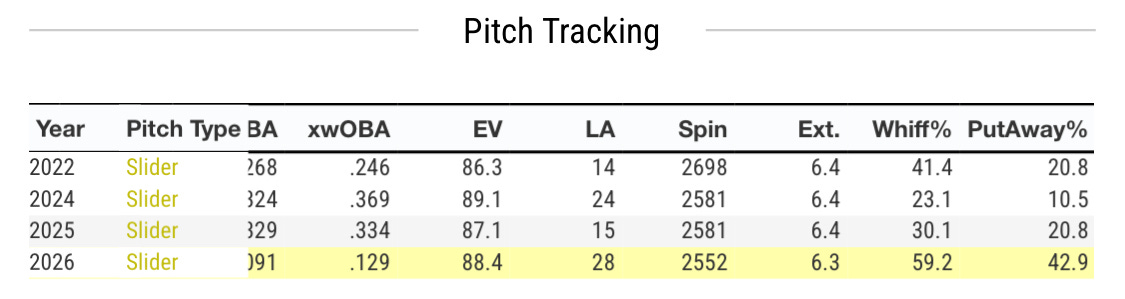
That slider suffered as Martin tried to find himself and slouched to a 4.16 ERA across ‘24-25. But he reworked the slider on the fly last year, into a gyro-style pitch which now gets 3.5” more drop and almost 3” more glove-side movement.
This year, Martin’s slider’s 59 whiff% and .129 xwOBA are as good as it gets. That’s the second-best swing and miss rate on sliders in baseball, including relievers—only the superhuman Mason Miller’s is higher.
Because Martin only throws it 15% of the time, others’ sliders have a higher total Run Value.3 But if we normalize for usage, Martin’s 4.2 RV/100 slider again ranks second in the bigs, behind Miller.
After missing 2023 due to TJ surgery, Martin added a sweeper the next year because that’s what everyone does. He carried that into last season and experimented with a cutter (throwing just 41 total), at which point he was up to seven pitches. He was also one of the first adopters of the kick-changeup in a further effort to solve lefties.
That’s a lot of pitches but Martin didn’t really have a plan. He’s talked about the difficulty of adjusting in-season and that his offseason work clarified his approach, freeing him up to focus on each plate appearance.
Now he’s ditched the sweeper and throws six offerings at least 10% of the time:
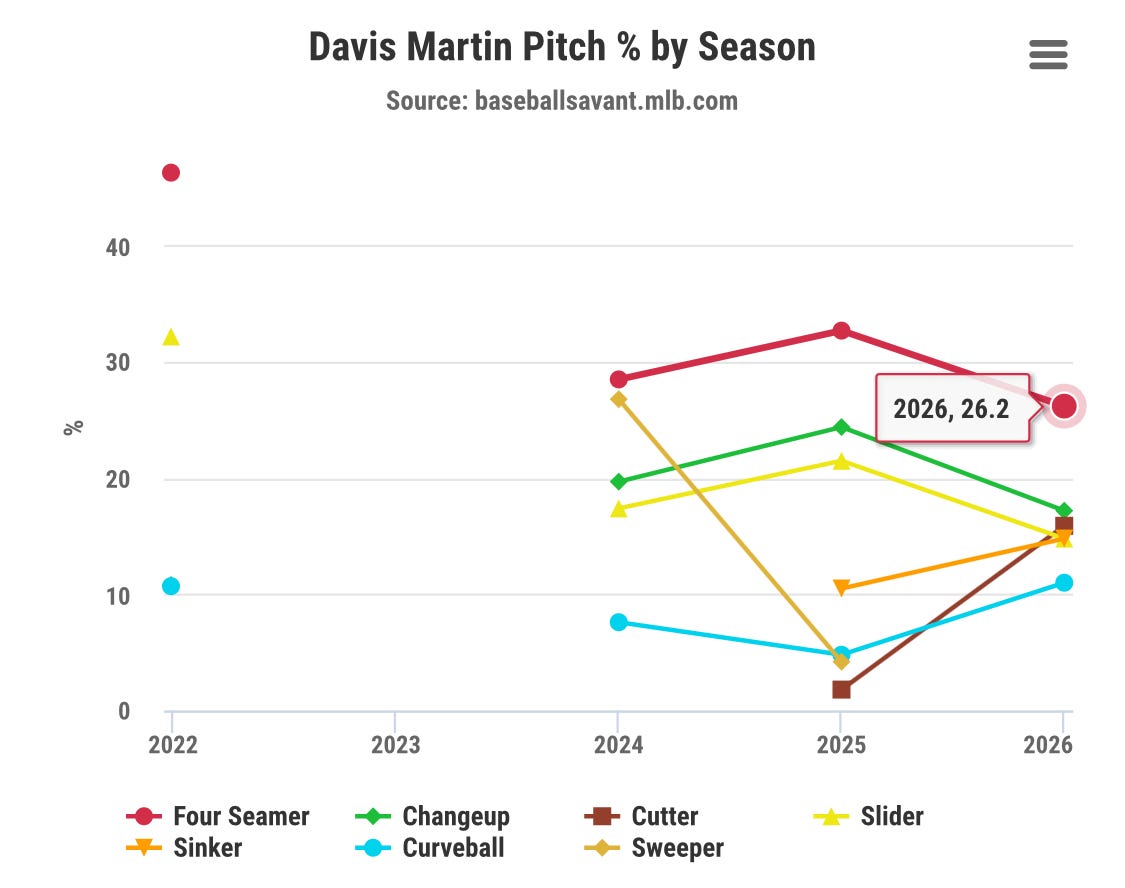
Martin’s brought down the four seamer, changeup and slider usage and leaned into that cutter. His curveball is better now too, and while the slider dives more vertically, the curve moves kinda like a, well, slider, with over 13” of lateral break. Opponents have managed a single single off the curve (.091 BA, .091 SLG).
Martin is throwing more sinkers, especially to righties, as a contact neutralizer. Eno Sarris and others have discussed how the multiple fastball approach has gained steam among teams and pitching labs (Cam Schlittler might be its patron saint). Having three hard pitches at similar speeds and release points, but with different breaks as they reach the plate, causes confusion for hitters. Even if the whiffs are lacking on sinkers and cutters, the batter is less likely to square the ball up and do what he wants to do with it.
Martin isn’t perfect by any means. Besides the curve, his pitches don’t land in extremely unexpected locations. In fact, there is some “bleeding” together, as opposed to specific pitches landing in specific quadrants:
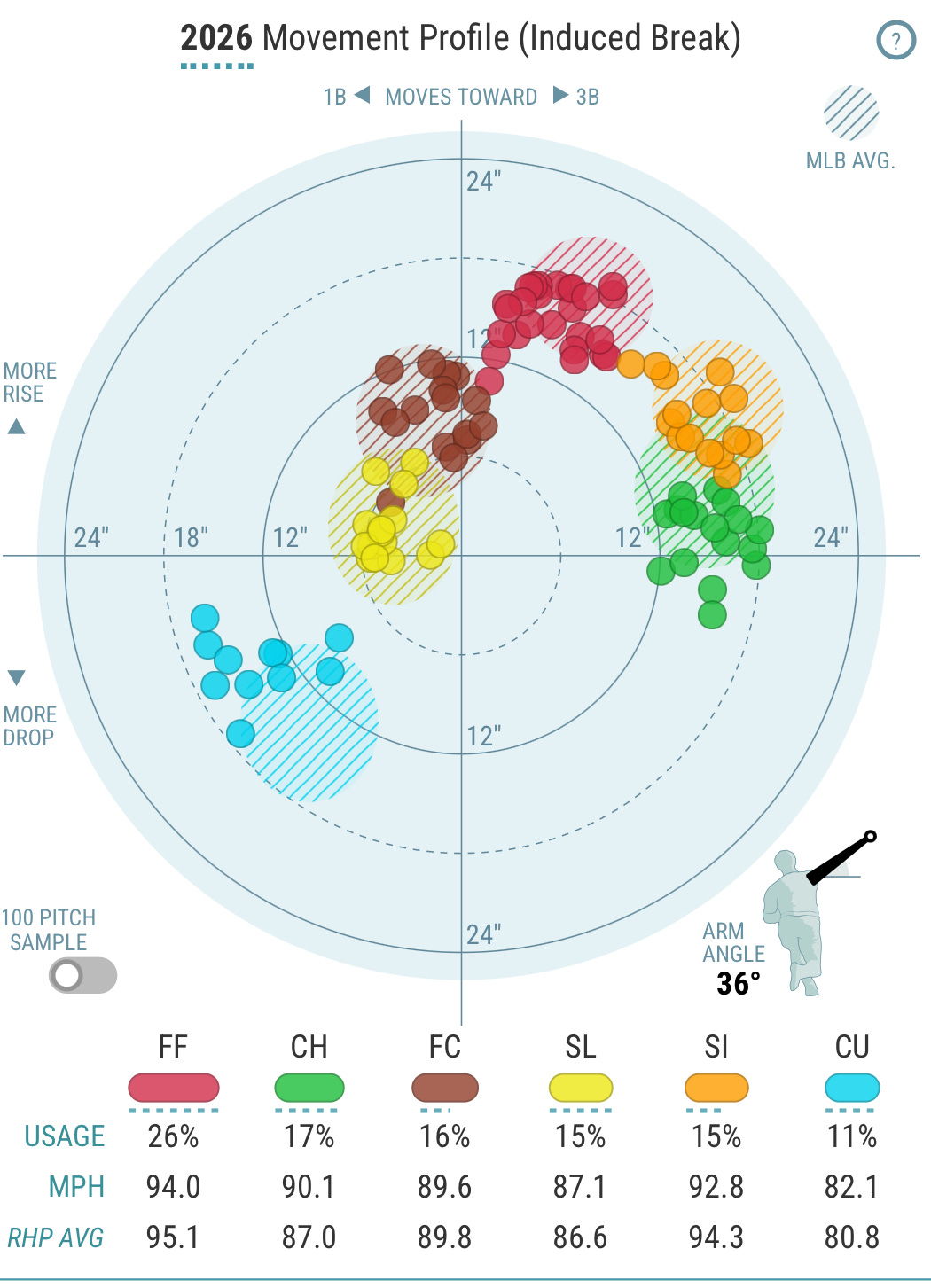
Globs of each pitch connect and overlap with others. Here’s the thing: we don’t know for sure that this is such a bad outcome. In fact, while stuff models aren’t impressed by Martin (96 Stuff+), he scores a strong 103 Location+ by FanGraphs’ model. Others who are more location over stuff: Eovaldi. Peralta. Imanaga.
But aside from the fact no one puts up sub-2 ERAs, there are regression flags here. Martin’s four seamer allows a .325 BA (.306 xBA), the changeup’s .273 SLG is belied by a .519 xSLG, and while the cutter may tie the room together, opponents are slugging .708 against it (.668 xSLG). Some of the exit velocities are perilous.
We talked about the length he’s providing, so it’s worth noting Martin has also generated fortunate splits third time through opponent lineups. Despite a much worse .293 BAA and 9.3 K-BB%. compared to the overall numbers, his 1.84 ERA in that split is floated by a 95.2% strand rate and just one home run allowed.
As always, the pertinent question is, regress to what? Martin currently has a 3.20 xFIP and 3.29 SIERA. The 4.22 xERA is scarier, but he’s a viable fantasy starter even if he lands in the mid to high-3’s.
I sometimes shake my head when I hear a fantasy analyst talk down a guy they estimate as a 3.6 ERA-type arm (looking at you, CBS). You know how many qualified starters had a sub-3.5 last year? 17.
Fine, Davis Martin may not be a top 100 fantasy asset. But he’s plenty useful now, and he’s ours.4
***
Grumpy Sports Grammarian
I have a lot of choices for the inaugural GSG, but let’s go with “as of late.” This redundant expression is ringing in my ears and searing my retinas practically every day. It’s ubiquitous in sports contexts, from the Kings local broadcast (yes, I watched a bunch of Sacto Kings games) to the preeminent fantasy news site, Rotowire:
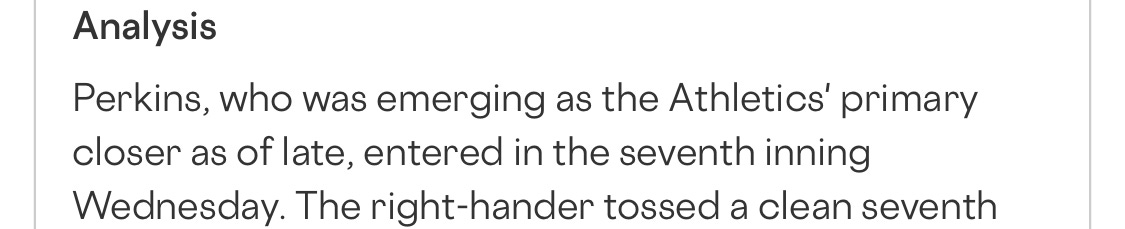
I didn’t even have to search for it! The Perkins update was third on the news scrawl as I wrote this (also, wtf with the Perkins usage? Anyway).
The “as” here adds nothing but clutter. “Of late” is a dictionary-defined phrase, meaning “in the period shortly or immediately preceding : recently” per Merriam-Webster. If you wrote, “Perkins was emerging as the primary closer as recently,” is that even English?
Some reasons to use “of late” instead of “lately” or “recently”? To avoid redundancy or sound more formal.
“As of late” has no dictionary meaning. It’s a double-preposition phrase, which is prima facie odious, and overly long because it means and is used for the exact same reasons as “of late,” which is shorter and, again, a defined and well-understood phrase.
See that last sentence? That’s the only reason to use “as” and “of late” together. That’s because “as” has its own meanings and purposes, including as an adverb, conjunction, pronoun, and preposition—none of which justify or explain using it next to “of late.”
Hitter Quickies:
Sal Stewart looked like a top 5 pick after three weeks (.310, 5 HR, 3 SB, 1.069 OPS, 182 wRC+) . But he’s only hitting .205 with a 72 wRC+ since mid-April. Even then he’s only struck out 19% and added 4 HR/4 SB (make it 5 HR after Wednesday night). We love guys like this who do something even when slumping. Sal has crushed fastballs (.311 BA, .451 wOBA) but is batting sub-.200 vs breakers and offspeed. Opponents have adjusted, throwing 3% fewer heaters with a corresponding rise in offspeed pitches. He’ll be fine at the dish and quite good for fantasy, especially given the predilection to run. In fact, Stewart has accrued more Baserunning value towards WAR (1.2) than his famously fast teammate…
Elly De La Cruz, who has “only” accrued .9 BSR value. However, Elly has cleaned up the defense and emerged as a true force at the plate: .265, .847 OPS, 132 wRC+, 10 HR, 8 SB. That’s a 42/35 and 8-WAR pace. EDLC looks a little more filled out this year, and he’s maintained his contact rates while upping the avg. EV (93.5), barrels (15%), and most importantly, launch angle (14.3°). He still doesn’t pull the ball in the air—10.8% is 6% below league median—but his power is so immense, and home park so small, it hardly matters. Even if he just meets his ROS projections, Elly would deliver a 30/40/.260 season and have us all wondering why he didn’t go closer to, or ahead of, Bobby Witt in fantasy. Heck, with Ohtani off to a slow start at the plate, Elly is worth a sprinkle to win MVP (he is fourth on FanDuel at +2500).
I’m not that worried about Kyle Stowers… yet. He’s hitting .224 with no homers and a .594 OPS. But it’s only been 15 games since he missed over half of spring training and most of April with a hammy. His bat speed is good, walk rate is up (11%), and Ks are down (24%). He’s chasing more and the launch angle is into the ground, but the 56% hard-hit says he’s healthy. Pretend it’s April 10 because that’s how much he’s played.
Earlier in his career, I simply referred to him as Martin Davis as a nod to his irrelevance.
Or models. This Baseball Prospectus study explains four new metrics designed to judge effects of deep arsenals, tunneling, and deception. Don’t let the cover boy detract from the broader point:
https://www.baseballprospectus.com/news/article/96026/introducing-new-arsenal-metrics/
Per Savant, Run Value measures “the run impact of an event based on the runners on base, outs, ball and strike count.” See:
https://tangotiger.com/index.php/site/article/run-values-by-pitch-count
Unless he turns into a complete pumpkin. Then you never read any of this.