
January Baseball Odds & Sods
Trevor Rogers’ luck, Crews questions, Bregman’s value, Kauffman makeover, Tucker’s deal makes Cheapo’s Cry

Trevor Rogers bounced back from a poor, injury-riddled debut with Baltimore to post one of the more surprising renaissances of 2025. After flashing dominance with Miami in 2021, Rogers wandered a wilderness of rehab stints and general ineffectiveness over the next three seasons: 7-24, 5.09 ERA (4.42 xFIP), 1.52 WHIP, 8.01 K/9 (249.1 IP). The estimators (4.42 FIP, 4.55 SIERA) indicated some poor luck but hardly a hidden gem, and hence Rogers had become an afterthought in fantasy.
The deeper one dug, the worse it looked: his composite 9.8% SwK rate from ’22-24 screamed sixth starter after he’d missed bats at a superlative level (14.1% SwK) in that breakout ’21. Rogers’ velocity fell each season, from an above average (for a lefty) 94.6 mph to 92.1 in ’24.
None of that deterred Orioles POBO Mike Elias, who clearly saw reclamation potential when he traded two of his top-10ish prospects in Connor Norby and Kyle Stowers for Rogers at the ’24 deadline. It seemed a dubious bet even before Rogers threw up a 7.11 ERA and 2.2% K-BB% over four starts with Baltimore post-trade.
The deal looked outright disastrous early last season as Stowers slugged his way towards the NL All Star team while Rogers’ season was delayed by a right knee subluxation.
But then Rogers returned in mid-June and just as we all expected, he pitched like…one of the best starters in baseball? He dominated the Red Sox at Fenway (6.1 IP, 5 H, 0 BB, 0 R, 5 K) and never looked back. Despite getting rocked by the Yankees in his final start, Rogers racked up a 1.81 ERA, .90 WHIP, and 8.54 K/9 over 109.2 innings. He allowed just six home runs all season; take out that last start and it was only three. Heading into the Yankees game, Rogers held a ridiculous 1.35 ERA across his first 17 starts.
The fantasy market isn’t fully buying it—Rogers’ Draft Champions ADP is 164 (SP53)—and why would it? Hell, we wouldn’t expect Skubal or Crochet to post, let alone repeat, a sub-1.9 ERA.
We haven’t clicked him yet, but we noticed a few Rogers nuggets from last season. His velocity mostly came back (93.1), if not quite to his prime levels (94.6). His command was excellent (104 Location+). Rogers’ riding four seamer destroyed opponents on both sides of the plate (.197 xBA, 24.2% whiff). He reduced the spin on his changeup as it induced grounders (-3° LA) and returned 27% whiffs. In general, he managed the more whiffs in the zone on every pitch; at 20.2% overall it was his best mark since 2022:
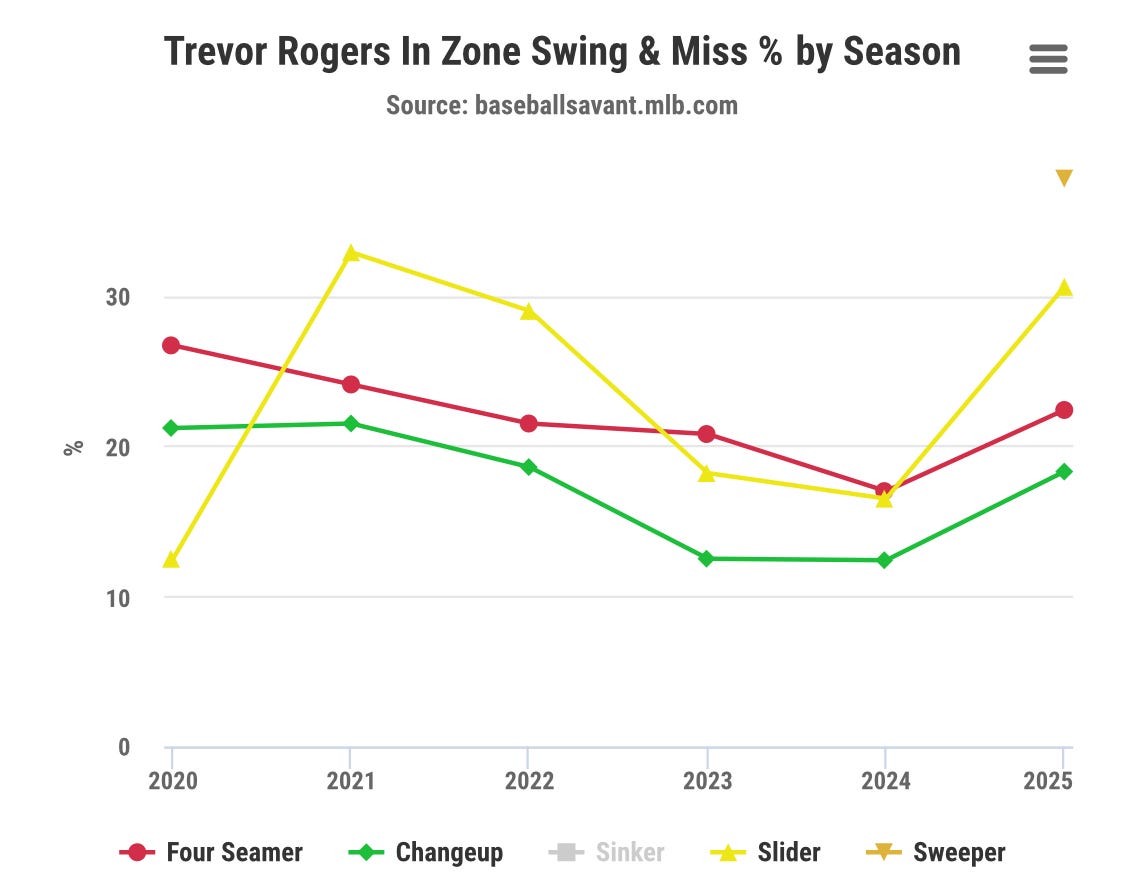
(I took out sinkers because he threw ONE in 2021 and got a whiff, which skewed the entire graph—and sinkers aren’t really whiff offerings anyway)
The most important change was pulling down his sinker usage by about 10% and splitting his breaking ball in two. He retained his bullet slider but also added a slower, short sweeper: the latter’s 7.6” horizontal break was a full 7” less than league average for its velocity and arm angle. The sweeper had a 37.8% whiff rate in zone; that’d be a good number overall. Both sliders flummoxed batters to sub-.070 BAA.
Of course Rogers got lucky too. His 84.2 LOB% was a full 14 points higher than his career number and ranked fourth among SP (min. 100 IP). Good pitchers run higher strand numbers but that’s obviously extreme. He was also nails in hitter’s counts: Rogers allowed zero runs at 3-2 and 2-2, despite a 21.6% walk rate in full counts.
Again, I haven’t drafted him but that’s more a product of looking at other positions in his ADP range. Among starters, it’s Rogers vs Castillo, Shota, Suarez, Bibee. I like Rogers better than those guys in general and as an upside play, although Bibee looks like a good bounce back bet and Castillo/Suarez offer safety if we’ve taken risks earlier. (I am off Imanaga this season, so you should probably draft him).
Dylan Crews, what art thou? His draft pedigree (third overall) plus elite speed and above average power says this should be a star. Yet through two partial seasons he’s struggled to a .211 average and .634 OPS. While the hit tool was never heralded as his best trait, FanGraphs gave Crews a 45/50 grade there and he seems to make enough contact (87% zone, 73.6% overall). The career 22.5% strikeout rate is neither good nor bad, but it’s passable if Crews’ expected power develops.
However, the actual power metrics are similarly neutral. Crews’ 89.5 EV and 8.7% barrel rate are above average but don’t scream intense game power. He did hit a ball 111.1 mph last season and showed above-average 73.3 mph bat speed. But too much of that contact is on the ground (52.1% GB% vs 44.2% league average). When he does get it in the air, Crews isn’t pulling it enough: 11.9% Pull Air% is well below the league average 16.7%.
On the other hand, Crews did at least hit pulled fly balls pretty hard (99.7 EV, 50% BRL%), and during his late season 2024 callup, he posted an 83rd percentile damage rate, per Robert Orr’s app. That was a smidge ahead of Willy Adames and a little behind Julio Rodriguez. (Damage rate incorporates EV, launch, and spray angles to capture extra-base hit potential). That dropped to 53rd percentile last year, but given injuries it’s fair to latch onto the debut number or at least expect something in-between.
The other issue we noticed: Crews has knocked 13 homers in the majors and all have come against fastballs. The last two seasons he’s hit .180 and .098 against breaking balls. The numbers versus offspeed aren’t much better. Here are percentile ranks for his whiff rates against all secondary pitches:
2025: 38% (24th pctile)
2024: 33.3% (43rd %)
Again, it was better as a debutante so the injury rationalization is there for us. Still, we’d like to have seen some damage against breakers or offspeed stuff.
Crews garners juicy fantasy projections for next season: 20 HR, 25 SB, .243 from FGDC and 16/24/.236 from The Bat X. He always seems to get picked before we’re ready to click his name (167 ADP), but I get the appeal. The upside case is full health, everything clicks, and we get a 20/30/.260 season. The Nats will surely let him play through any struggles and the cost allows for a bad pick. Just be aware of the flaws, which now include credible hit tool questions as well as health concerns.
Kyle Tucker signed with the Dodgers for 4 years, $260 million and it’s opened the usual “west coast evil empire ruining baseballneedsacap” blather. Just a couple observations: the only reason LA, who were never rumored to be interested in a long-term Tucker deal, were able to swoop in and get this done is the artificial, self-imposed fiscal “responsibility” of teams like the Yankees. If either New York team—the Mets made an offer 90% of LA’s but also for four years—or any number of other orgs, had been willing to go to seven or eight years, Tucker is likely already signed and there’s no opening for the Dodgers. The Yankees not being rumored as even interested in Tucker seemed odd—their biggest signing was Amed Rosario until the Cody Bellinger staring contest ended yesterday—but maybe Hal Steinbrenner wanted to stay consistent after his embarrassing claim last offseason that it’s “difficult” for others to spend like the Dodgers.
Unfortunately, by taking advantage of Tucker’s softer-than-expected market, the Dodgers provide jet fuel to the salary cap/lockout crowd. Obviously that includes Manfred and a sizable contingent of owners, who Evan Drellich described as “raging” over the deal.
We have written before about cheapskate owners pocketing revenue sharing money while crying poor, the ways fans make apologies for those parasites similar to the broader societal tendency to rationalize corporate welfare while demonizing community-oriented investment, and the numerous externalized benefits that enrich all owners (community gifts of stadiums and land, tax laws allowing sports owners to write down personal losses along with team depreciations, etc.). Sports is the only industry where a competitor is guaranteed hundreds of millions in revenue just for existing. For example, why do we not expect the Marlins of the world to market and sell their own streaming rights? Live sports is the most valuable commodity in viewable content but if the automatic dollars from an RSN stop, these teams are helpless puddles of goo. Of course to sell something you’d have to make it appealing, which requires investment in players, and we’re back to square one because none of 20-odd teams have to make such reinvestment. Indeed, Drellich also reported that some owners aren’t sure if a cap would be more beneficial than the current system because god forbid, they’d have to agree to some reasonable spending floor as well.
Other sure things: 1) the league’s salary cap push is less about “competitive balance” than it is about cost controls; 2) caps don’t fix cheap or stupid (see Browns, Hornets, Jets, Kings, Jazz, etc.); 3) once the owners institute a complex cap architecture with onerous aprons, providing cover for their parsimony and making it impossible to keep good teams together for more than two seasons, many of the same folks screaming about the Dodgers will bemoan the new system.
Speaking of frustrating ownership groups, Alex Bregman gets super ultra giga-paid by leveraging competing interest from the Red Sox and Cubs. Bregman signed with Chicago for five years, $175 million but with deferrals that take the present-day value closer to $150m.
We say frustrating because Boston and the Cubs rank top five or six in revenues but typically lag in the middle or even worse in terms of revenue invested back into players. For example, the Cubs continuously try to stay below the first CBT luxury line, to the point that rumors began to fly that the Bregman signing may prefigure a trade of Nico Hoerner, who’s been a 4-WAR or better player four straight years and is a bargain at $12m. This is like painting your living room but replacing the gorgeous carpet you installed last year with linoleum. A team like the Cubs can afford both, especially given the gold mine of their developments in Wrigleyville.
Meanwhile the Red Sox have famously found reasons to trade their best players in recent years, first Mookie Betts in 2020 (is that the Dodgers’ fault?), then Rafael Devers last season, while simultaneously developing nearby land like mad, such as “The MGM Music Hall at Fenway” right next door to the park (reviewers complain of “very” narrow seats, perhaps a necessity to fit all that branding on the marquee).
We’ve also written about this before, but worth noting that the Sox and Cubs recent obsession with payroll efficiency coincides with both organizations selling minority stakes to private equity firms (Arctos Partners has shares of both teams among a six-team MLB portfolio, while RedBird Capital owns a chunk of Fenway Sports Group, the Red Sox parent company). To add to the connection, after he ran the Cubs, Theo Epstein returned to the Sox in recent years as a “senior advisor,” which followed Arctos adding him as an “advisor.” It makes sense that Epstein is doing a lot of advising for everybody—he also holds ownership shares in FSG and is an executive partner for Arctos (but no shares! He doesn’t kinda sorta also own five other MLB teams!)—given that he is one of the first baseball execs to stress efficiencies, leveraging analytics, etc. That’s led to some positive trends of course, but we’d argue the Moneyball and early Epstein era allowed the biggest market teams to co-opt the small-market mentality, which they happily sell as “fiscal responsibility” to fans.
In this environment, we kind of appreciate the Dodgers unabashedly embracing the part of financial titan. (And just to complete the circle, guess who also owns a Dodgers stake? Arctos).
Anyway, Bregman’s ADP might be creeping up. Look at this trend, especially around January 10 when he signed:
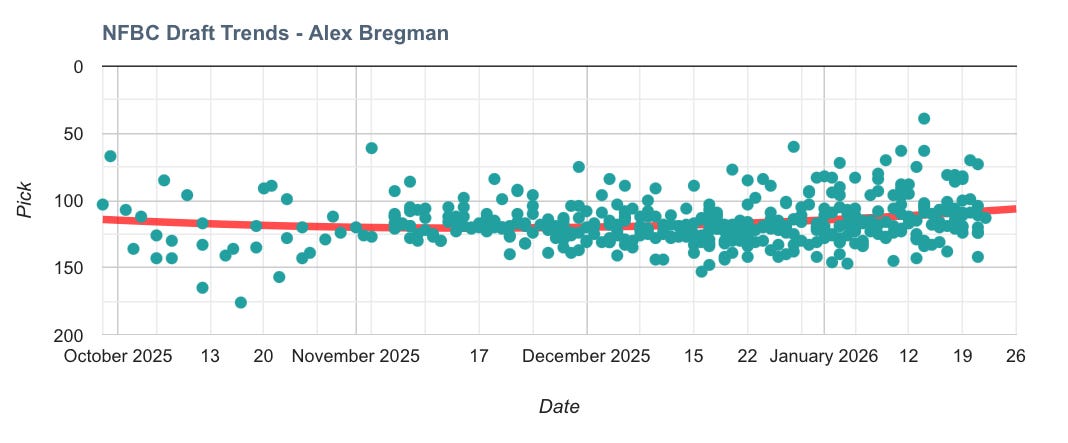
That peak dot up and to the right? Pick 39!
Most notably, it’s not clear that Wrigley is a great landing spot. Although better for right-handed homers (102 park factor vs 90 for Fenway), it is considerably worse for righty offense generally (96 vs Fenway’s 120). But that 102 for homers is based on a three-year park factor and in reality, Wrigley is at the whims of the wind. Look at the RHH HR factor year by year:
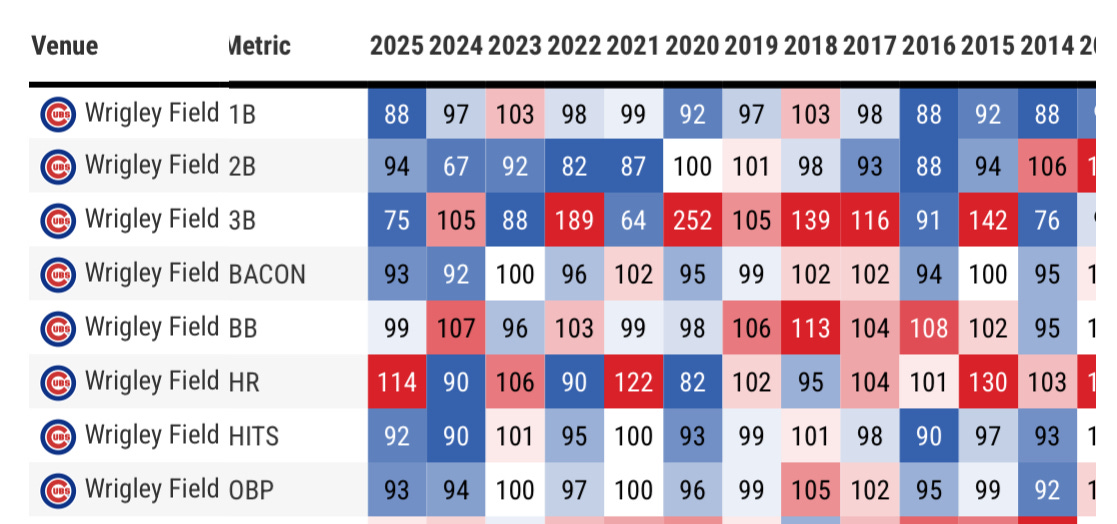
Bregman is a pull and lift power guy; the EVs are middling. His bat speed ranked 31st percentile last season and his 9% fast swing rate was well below league average (31.2%). If the HR factor truly alternates by year like Aaron Nola’s ERA, we may be due for a down power 2026 for Cubs righties. More seriously, that chart says we just don’t know. If the wind is blowing in, Bregman would be affected more than most. None of which is to say he won’t be valuable, but we weren’t thrilled with him around pick 120. If he’s moving up a round or two, we are totally out in roto leagues.
We also thought of a quick and dirty Bregman comp that may indicate this contract will age poorly. Bregman’s position and hitting profile—high contact, pull-lift power, dubious EVs—resembles no one so much as Nolan Arenado. Bregman takes more walks so his OBP should float his batting value a bit longer, but Arenado started from a much higher plane as a defender.
Most interesting are the uncanny similarities in terms of their power skills. Here is their statcast data on pulled fly balls and liners from 2020 through 2022:
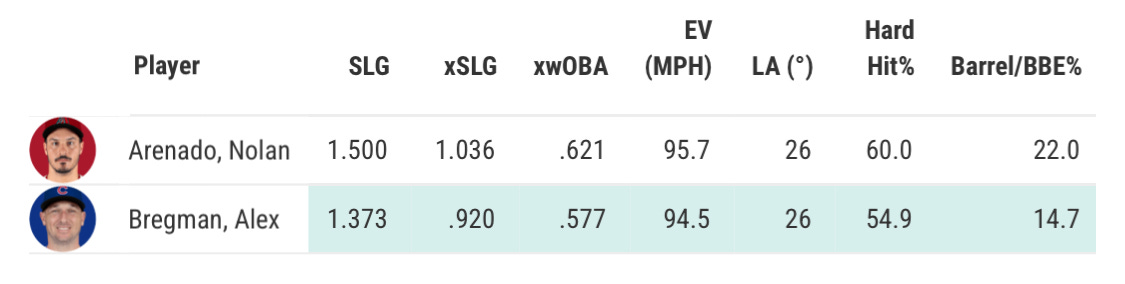
Despite being three years older, Arenado was actually driving the ball in the air harder than Bregman.
Arenado’s overall production began slipping in 2023 (107 wRC+ from 130 over his first two Cardinals seasons). Then look what happened the following year on air balls hit to the pull side:
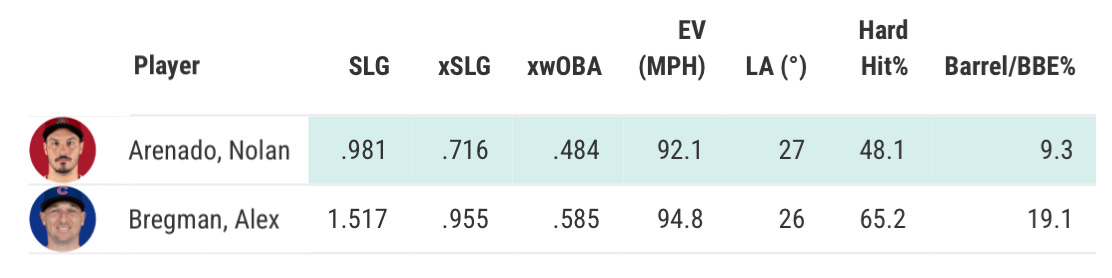
Finally, Arenado played at 32 years old when his decline began. Bregman will turn 32 this March 30, a few days after the Cubs season opener.
Oh by the way, the private equity bros aren’t just buying up and chewing through chain stores and distressed farmsteads: they’re busy snapping up baseball farms too: https://www.sportsbusinessjournal.com/Articles/2025/12/16/arctos-partners-backs-prospector-baseball-group/
The Royals announced plans to move in the outfield walls to normalize home run rates at home:
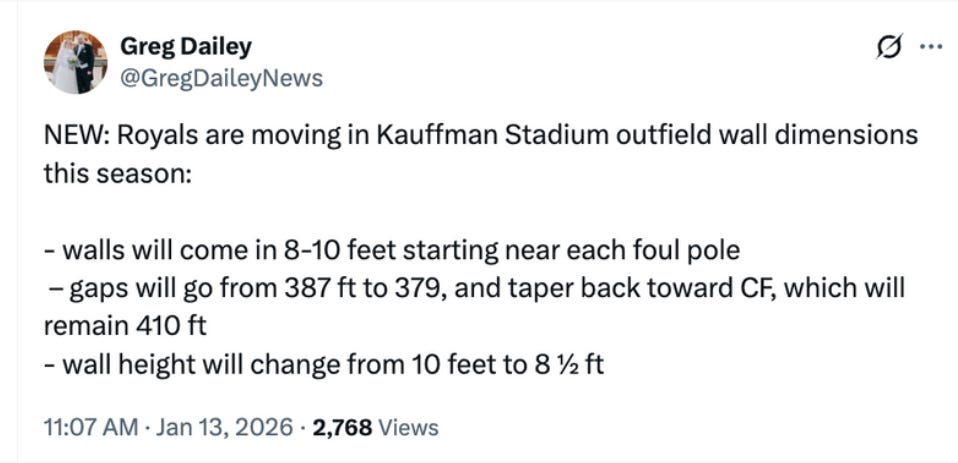
There’s been a lot of discussion and speculation on the effects of this park change, but the consensus agrees it will do as KC brass intends: home runs will go up. Ben Clemens of FanGraphs created a model to estimate the impact of the proposed changes—by his measurements, Maikel Garcia’s batted balls last year would have yielded 5 more homers, the biggest gainer on the team. I believe that is based on every batted ball, i.e., if Garcia had played every game at Kauffman.
(https://blogs.fangraphs.com/analyzing-kauffman-stadiums-new-dimensions/)
Also note that the Royals made almost this exact same change back in 1995-2003. Jordan Rosenblum, also of FanGraphs and the creator of the OOPSY projections, went back to FG’s historical park factors database to show how a similar move impacted scoring then:
A 10-point jump in homers is massive, and it didn’t even kill the triples last time. Kauffman was already a plus offensive park due to the ginormous outfield and resulting extra base hits, but Witt, Vinny P, Garcia and Salvy playing at the equivalent of Great American small park? GASP! (Ok, sorry, that’s terrible).
As others—including Ben Lindbergh and Meg Rowley of the Effectively Wild pod—have noted, the general rush among teams to make every park’s dimensions and features roughly “normal” within a certain band is a little sad. I miss the sheer right field overhang of old Tigers Stadium, the weird nooks and insane wind effects of Candlestick, even the giant foul territory of the recently deceased Oakland Coliseum. While we appreciate that players don’t want to be penalized by weird dimensions, as well as the teams’ preference for consistent data, the trend toward average is still boring as a best case, and/or indicative of a broader societal drift towards sameness and efficiency and away from random mystery in the worst.