
Checking On Funky Lefties In An ABS World
Breakdowns of Boyd, Abbott, Lopez, Cantillo; Rice and Tucker Blurbs; GSG and “Hone in on”

We broke down the curious case of the dominant slow ball lefties late last season: Matthew Boyd, Andrew Abbott, Kris Bubic, Jacob Lopez, et al.1 Their results beat their failing Stuph grades by a combination of good locations, a slick secondary (usually a changeup), and the lefty uniqueness penalty.
Last year lefty starters as a whole distanced themselves from the majority:
‘25 RHP: 4.33 ERA, 4.30 FIP, and 8.2 K/9
‘25 LHP: 3.88 ERA, 3.97 FIP, and 8.5 K/9
But this season:
‘26 RHP: 4.12 ERA, 4.12 FIP, and 8.3 K/9
‘26 LHP: 4.15 ERA, 4.05 FIP, and 8.5 K/9
The gap is gone.
It’s especially true for the lower velo, lower stuff southpaws like that group above. Sure, OGs of this archetype Ranger Suarez and Eduardo Rodriguez are trucking along with top-20 ERAs below 2.5, but we aren’t seeing the same broader success.
Boyd and Lopez have ERAs around 6. Abbott just got his below four (3.88) thanks to a 1.29 ERA in five May starts. But even during this hot stretch, Abbott’s underlying case is far more rickety than last season: 15.9 K%, 10.6 BB% (5.3 K-BB%), .190 BABIP, 98.4 LOB%. These are silly—and unsustainable—luck factors. That works out to a 5.34 SIERA. It’s 5.03 on the season.
Abbott’s changeup is missing even more bats this year (19 SwK%), but hitters have also smoked it to a .300 BA. His slider whiffs have fallen off (13% from 18%) and he’s ditched a cutter that allowed damage but gave him another look vs righties. The real (estate) story? Locations. Last year his fastball carried a 23 K% and 9.7 BB%. Now it’s 9 K% and nearly 16 BB%. His command grades are down on everything but the slider, giving him a 100 Location+ vs 105 last season. The changeup took a hit from 107 to 89. The FanGraphs Bot model graded his command about 60 on the 20-80 scale last year. Now it’s 51, which incidentally is the same as Abbott’s 2023-24 grade, when he was a 3.8 ERA, 1.3 WHIP type.
It’s a similar story for Lopez: Location+ down from 102 to 99, walks up from 9.2% to 13.7%. The free passes aren’t mitigated by punchouts either. No one expected him to repeat a 27.7 K%, but 15.2%? We thought Lopez could give back some of his 18.5 K-BB% and still be useful, but now it’s 1.5%, which is of course terrible.
The rise in walks makes us wonder if this is an ABS issue. Lopez had a 37.7 ball% last year, a bit worse than average. Now it’s 41%, which is frankly unsustainable for a starter. Abbott had a good 33.8% ball rate last year, whereas now it’s a poor 38.1%.
The ball rate is only up slightly for starters on a league level, from 35.9% to 36.4%; for lefties its risen slightly more, from 35.4% to 36.4%. But last year we noted that Abbott and Lopez really lived on the edges. Moreover, the Reds have been the third-best team at ABS challenges on defense (+19.6 net wins, 72% correct) while the A’s have been among the worst (+3.8, 58%).2 Perhaps this helps explain Abbott’s May, at least to some degree.
But the challenge system has created a tighter strike zone, and it makes sense that a smaller zone would unduly impact these edge lords. Take Lopez. His entire approach depends on fastballs up and away to righties, with changeups down and away. Here’s his four seamer heat map last year, courtesy of FanGraphs:
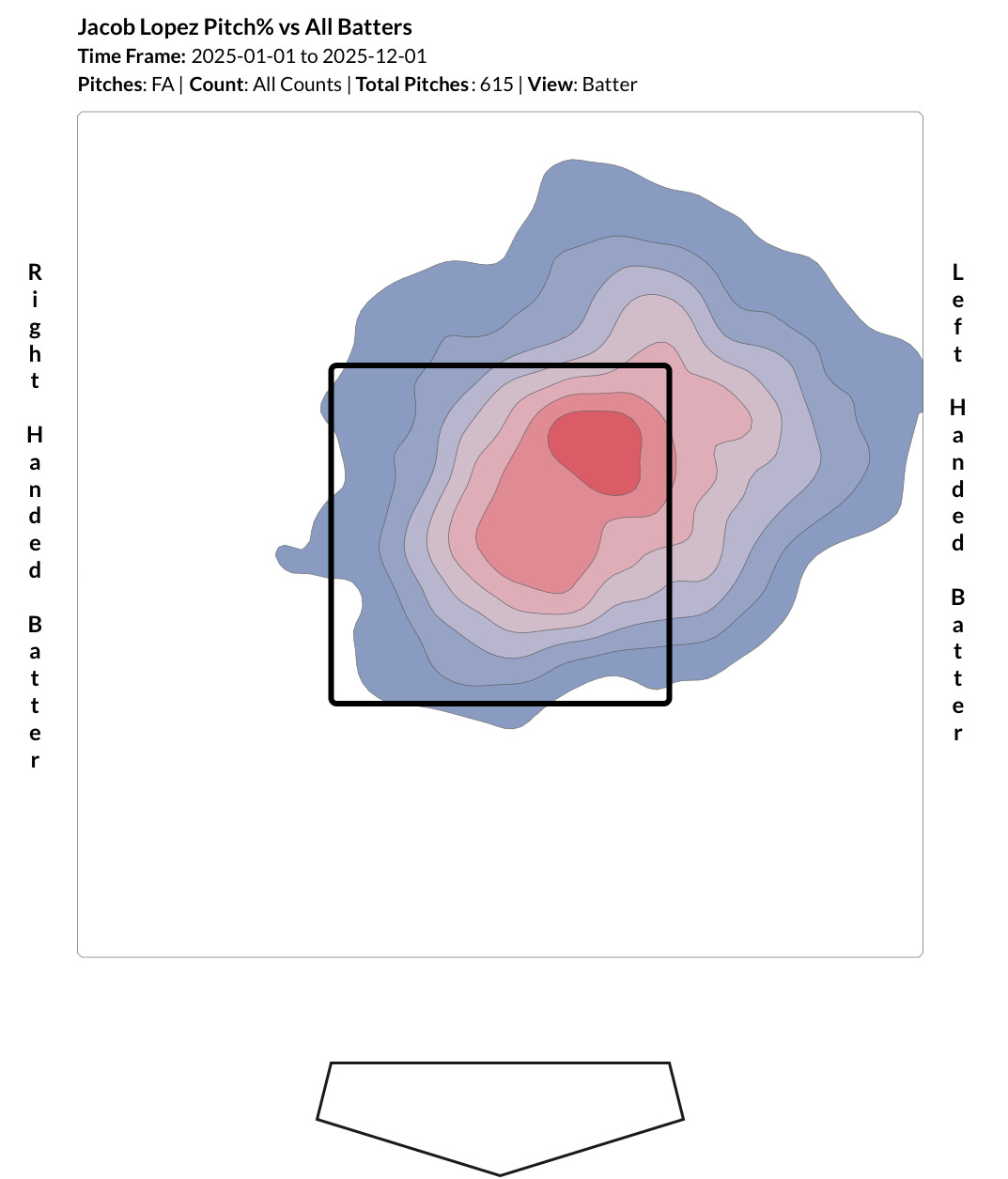
Compared to this season:
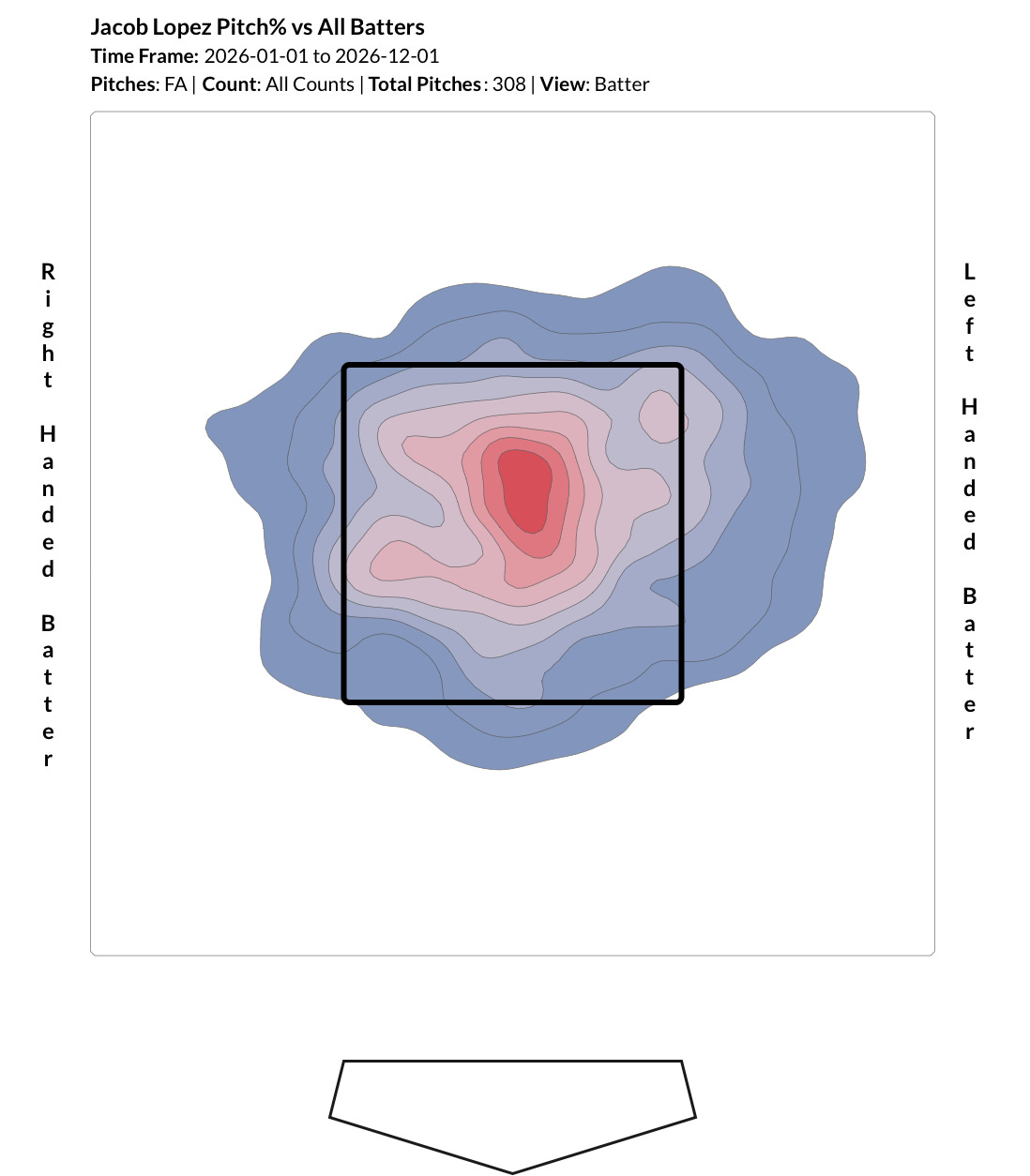
It’s a similar story with the changeup. His overall called strike rate is down one point and zone% is down 1.6, which are significant for these metrics. The walks are up over 4%.
Now, it’s likely Lopez wasn’t going to precisely replicate his perfect locations, but it’s easy to imagine that losing edge calls forced him towards the middle, where his dubious stuff becomes more vulnerable.
That’s of course why teams (and fantasy owners) chase the Miz and Skubal types who can throw to a dead center target and dominate based on superlative velo and movement. For Lopez, who sits around 90 mph, he has to dot the edges of the zone to be successful.
So we suspect some natural command regression paired with a tighter zone has bedeviled guys like Lopez and Abbott, driving up the walks and forcing them to thread a much tighter needle.
Matthew Boyd Is Actually Better Now?
Boyd only made five starts before being sidelined with a meniscus injury in early May (playing with his kids, continuing the long tradition of weird baseball ailments). On the surface, he also regressed in those 24 innings (6.0 ERA).
But even last year, Boyd was a different animal than some of the other mysterious lefty success stories. He threw a little harder, wielded a plus slider, and his fastball didn’t get crushed.
Well, despite the unsightly ratios, Boyd was showing even better skills under the hood this season. His fastball is allowing almost 200 points more by OPS, but he hasn’t lost the zone and it’s actually generated more whiffs (12 SwK% up from 7%). Meanwhile, his change and slider both have swinging strike rates of 18%+, both increases from last year. The strikeouts have risen 10 points to 31%! Boyd’s overall 14.2 SwK% is up 3.5 points, which would rank between Schlittler and Luzardo in the top 10.
Granted, some of these gains are likely small sample noise. But before he went down, Boyd’s command seemed to sharpen. Last year his heat maps showed fastballs and changeups mostly in the center of the zone. This season it was four seamers painted along the top rail and changeups homed in on* the bottom of the zone at knee level (*preview of this week’s GSG).
The robots see it too. Last season Boyd, like the other southpaws we profiled, had below-average stuff but the command captured by his 107 Location+ powered him to a 102 Pitching+. This year the locations jumped to 114 with a 107 Pitching+. The new number would’ve ranked top 15 last season.
Even if the strikeouts slip upon his return, Boyd hasn’t appeared fazed by the new zone. His 6% walk rate is almost identical to last year’s 5.8%. His surface stats are weighed down by a .377 BABIP, 80 points worse than his career, and a 49.7 strand% that’s 21% worse.
The projections have Boyd as a 3.8 ERA/1.20 WHIP arm ROS but he’s pitched to a 2.77 SIERA. We picked him up in a couple deeper leagues and look forward to rolling him out when he returns in mid-June. The Cubs will presumably rise from their offensive hibernation by then.
The Mystery of Cantillo’s K’s
Joey Cantillo is another lefty who thrived last year behind a great changeup and below-average fastball velocity. He showed real promise with a 27.9 K% and strong run to close the season in Cleveland’s rotation.
This year the strikeouts have dropped to 21.2% and on the surface, it doesn’t add up.
His 11.8 SwStr% ranks 23rd among qualified SP. So he’s missing bats.
He’s 30th in CStr% at 17.1%. Called strikes, check.
Put them together and he’s 19th in CSW at 28.9%. The other guys in the top 20 of CSW% are among the best strikeout arms in baseball.
But Cantillo’s 47th with a 21.2 K%?
We could break down his pitches; eg, the change and curve are dropping 3” less while the slider is dropping 12” more.
But the ultimate problem might be that Cantillo, like Lopez, has been squeezed by the zone. Despite a relatively good called strike rate, it’s down 2.3%. His zone% of 41.5 is down 5%, a huge number.
Cantillo’s also struggling in 3-ball counts. He struck out and walked about an equal 33% of batters in 3-2 counts last year. This year it’s 19.4 K% and 51.6% walks. It’s a similar story in 3-1 counts, where he’s walking 10% more and striking out 10% less than last year.
The issue reared its head Tuesday, unfortunately for those of us who started him against the Nats. He has Mead down 1-2, it got to 3-2, walk. Ran it full to Abrams, walk. That was just the first inning. In the second he walked two more and allowed a single and a homer. He was at 69 pitches, 4 ER, and done for the day.
It seems weird that Cantillo suddenly can’t put anyone away. But despite the whiffs and called strikes, it’s really hard to trust using him given that handicap paired with a double-digit walk rate.
Wacha Owns The Judge
Michael Wacha is an unassuming righty. He doesn’t throw hard and won’t dazzle any stuff metrics. But Wacha has a magic pitch in his changeup, and while we’ve had a recent unfortunate example of a player possibly buying a judge or three off the field, Wacha owns Aaron Judge on it.3
On Monday, Judge went 1-3 with a single against Wacha to bring their career matchup totals to 5-29 with two doubles, no homers, and 13 Ks. That’s a .535 OPS.
Changeups and splitters are regularly among Judge’s worst pitch types to face, but they’re usually a weapon lefties use on him. It’s rare to see many R v R changeups generally, and he performs a bit better in that split.
But Wacha has dominated this entire current Bombers’ roster. Their active lineup is batting .140 with a .466 OPS and over 30 K% against him.
This all got me wondering so I checked the team batting splits against offspeed pitch types.
As good as the Yanks are—their overall .753 OPS is third and 114 wRC+ ranks second—they really struggle vs changeups, splits and forkballs from righties. Against those pitch types vs RHP this year, they’ve mustered a .184 BA, .528 OPS, 59 wRC+. That’s 30th, aka last.
For the past calendar year in that split, the Yankees “boast” a .190 BA, .552 OPS, 66 wRC+ (25th).
Do I wish I knew this and started Wacha this week instead of Cantillo in one of my most important leagues? Yes. But also, it’s something to consider for any future righty on our fantasy squads who wields a great, heavily used offspeed pitch facing New York. (Walbert Urena for ex.—then again the Angels may not even tell him to throw it R on R). Usually the Yanks are an auto bench for non-aces. But for the right pitcher with the right pitch it may actually be an auto start spot.
Pages > Tucker?
If we told you back in February that Andy Pages would not only be the best Dodgers outfielder for fantasy, but their most impactful hitter, period, you’d probably quickly offer four or five other names (for ex., by ADP: Ohtani, Tucker, Freeman, Betts, even Teoscar).
Not only that, but with 12 HR, 7 SB, and .299 BA, he’s absolutely lapping Tucker, who has accrued a modest 4 HR, 4 SB, and a .243 BA.
The underlying numbers don’t say it’s wrong, either. In many ways—not plate discipline—they’re similar: players who exceed the limits of rather underwhelming exit velocities by making contact and pulling the ball.
Pages’ 8.2 barrel% is right in line with last year and his average EV is up 1.5 to 90.1 mph. But he’s not the story.
Kyle Tucker is the top 20 overall ADP player who can’t be found near the top 30 even at OF on Player Raters. He’s usually around a 10% barrel but it’s 5.2% now(?). That’s frankly middle infielder territory. (Maybe he should start a club with Vlad Guerrero, whose usual 12% barrel is down to 7%).
Tucker’s average EV is down one mph but nothing crazy; same with the bat speed, which lags half a tick. It is interesting to note that his max EVs formerly topped 110 regularly but have been closer to 107-108 the past three seasons. Again, that’s Zack Gelof territory.
However, much like his teammate Shohei Ohtani, Tucker is not hitting the ball as hard in the air. Here are his metrics on fly balls and line drives year over year:
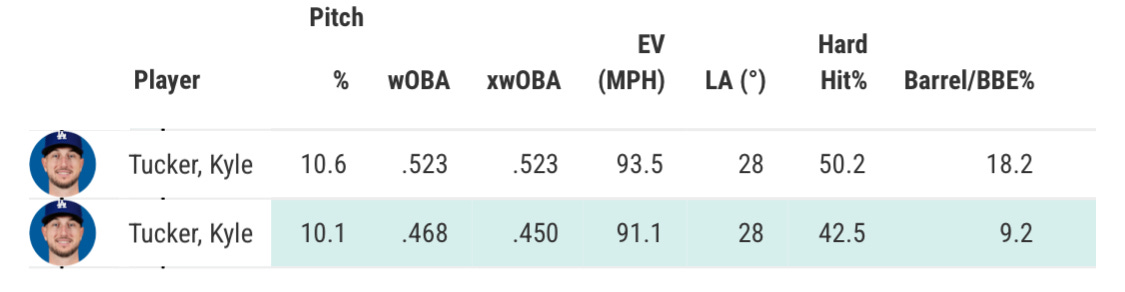
Take away every ground ball and his barrel% is still lower than last season’s overall number. He’s hitting a similar number of flies and even pulling in the air more regularly, but there’s a decided lack of oomph on his air balls (yes, of course I went out of the way to write “air balls”).
Can’t blame the ball park, as Dodger Stadium is one of the friendliest venues for LHH power. For example, if Tucker played every game at Oracle in San Francisco, he’d have one home run!
It’s hard to say what’s cause and effect here and he’s no Tatis, but we’re getting to the point that even reaching his ROS projections will make a 20-homer season a close call.
Overcooked Rice?
I have a number of Ben Rice shares and when he went down with a thumb contusion May 3rd, I was glad he avoided the IL but did worry that at minimum it might break up the 1.100 OPS rhythm he held from Opening Day until that point.
I mean, duh, he wasn’t going to maintain a .500 wOBA and 224 wRC+ all season. But there have been some slightly distressing signs since the injury.
Rice missed four games and since returning May 8 he’s hitting .197 (76 wRC+). He has popped four homers and his 24 K% is steady, but after walking almost 17% of the time pre injury, it’s been 4% since.
Now there’s no way he keeps running a .200 BABIP either, but if his thumb were bothering him it may look like his Statcast decline: EV is down 3 mph to 89.5, barrel rate is down 3% to a still-good 14%, and hard-hit% is down 10 points to 43.5%. Again, these numbers are fine. But they ain’t peak Rice.
Even last year it was a 55.8 HH% and 93.6 EV. He’s more uncle Ben than sushi right now, though he has gone 5-9 with a double and triple in his last two so maybe he’s rounding back into form.
**
Grumpy Sports Grammarian
This one has not only left the station, it’s gone like one of those Chinese Gaotie bullet trains. But I really wish we could roll back the tides on the phrase “hone in on” to mean someone is focusing on a target or objective. Have you ever heard of a hoNing pigeon? Are advanced missile systems guided by hoNing devices? Are submarine commanders pulling out a whetstone and rubbing it against a radar screen?
Yet we often hear a player or coach say something like, “he’s honing in on the problem/issue.”
There is no definition for “hone in on,” while Merriam-Webster has an entry for “home in on”: “to find and move directly toward (someone or something).”4
Now we get the idea of “hone” as in, to sharpen a skill, the figurative sense of sharpening a knife. But in that case it’s not necessary to use “in” or “on” afterwards. He honed his mechanics during the offseason, for example. That would mean to repeat or sharpen the process.
If a player has lost a skill and searching for it, we’d say, He’s homing in on the problem with his mechanics. Again, think homing pigeon or homing device.
Bend Sinister

It’s hard out there for lefties in a righty-dominated world. Learning to write is a trauma of bleeding lines and inky fingers, doors swing open to the right side, and playing shortstop (or taxing billionaires) is strictly verboten.
We’ve been assembling various notes for a full anti-challenge system article. tl;dr: accuracy is the ultimate goal for balls/strikes, so let’s not do a half measure that allows for hundreds of missed calls; I don’t want players acting as officiants, baseball was fine without it; and btw, the umpires preferred full ABS because yes, the “fun” (and most importantly, sponsored) game of showing the result on the Jumbotron is embarrassing for them.
On Monday, Wander Franco was found guilty of sexual and psychological abuse of a minor (for the second time), but judges in the DR issued a simultaneous judicial pardon because he was a “material victim” of the girl’s mother—who charged him money to consort with her—even though he is not a “legal victim.” Uh huh. Not shady at all. Also, next time you wonder about lawyer bills, remember how fucking gross the work can be.
There is an entry for “hone in,” without the “on,” but it denotes this as an informal usage. The attached note acknowledges this type of usage, but explains it is not technically correct: “careful writers will want to use ‘home in.’” We are nothing if not careful.
https://www.merriam-webster.com/dictionary/hone%20in