
%*$# This!
Grawlix Roll Call—Fantasy Baseballers Who’ll Make You Curse Their Names

Censorship is unfortunately ascendant across the internet—it only took US “investors” replacing the CCP as TikTok owners to suppress certain, totally not targeted, speech on the platform—so in the spirit of the zeitgeist let’s use a more innocent form of the concept as a frame to discuss fantasy baseball players we expect to frustrate us this season.
“Grawlix” is the term that describes a string of non-alphabetic symbols used to denote curse words. The first grawlix appeared in a comic strip in 1901, although the term didn’t exist until cartoonist Mort Walker, creator of Beetle Bailey (which still exists?!), first used it in 1964. Walker’s grawlix may have been inspired by “growl,” per Wikipedia. It became a proper dictionary word in 2018, when Merriam-Webster first blessed it with inclusion.
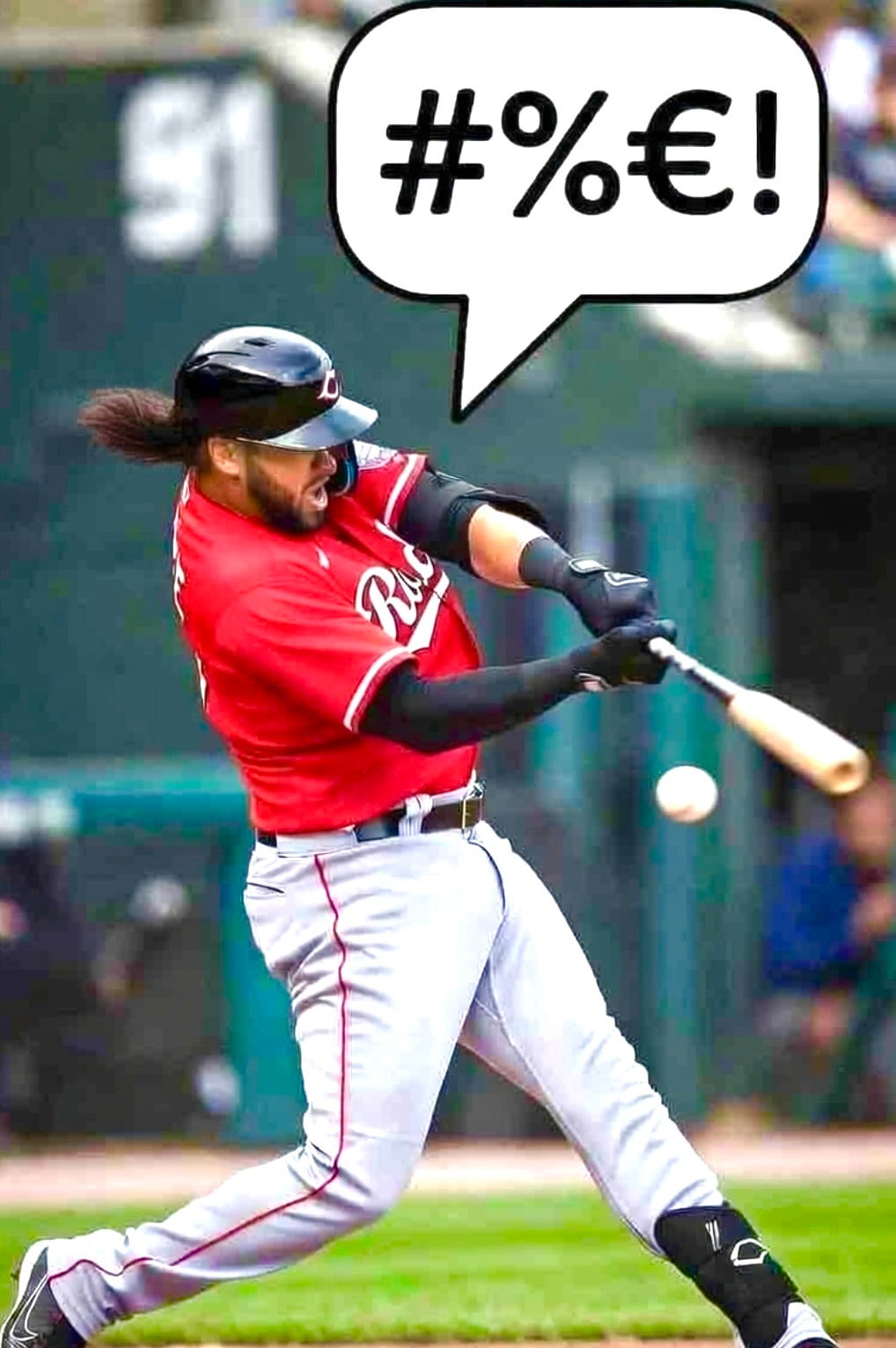
(Our humble, AI-assisted rendering of Geno Suarez emitting a grawlix)1
Growl, curse, a string of unpronounceable sounds: whatever you want to call it, every fantasy owner has denounced disappointing players with florid profanity upon checking the latest underwhelming box score or injury alert.
Identifying the completely catastrophic picks is difficult, whether by being too obvious or by relying on some injury predicting voodoo none of us actually possesses (nonetheless, we’ll try in an upcoming article). Instead, today we’ll focus on players that are simply being overdrafted based on projected value and our analysis of their upside cases.
Average draft position (“ADP”) is taken from NFBC Draft Champions over the last 30 days. Using the Bubba & The Bloom projection aggregator, we list the player’s overall roto $ value, ADP, and then hitter rank minus hitter ADP rank with the difference.
—
Mookie Betts (SS) ($17)
ADP: 62 | H48 - hADP 58 = -10
It’s tempting to draft a talent like Betts when he drops from his usual second-round cost to the fourth or even fifth round, especially when a ready-made excuse for his poor 2025 exists in the form of a severe illness that caused him to lose 18 pounds just before last season began. Mookie later said he also started pressing after the slow start. But it’s worth noting his exit velocities and barrel rate began dropping the prior season. He only lost .5% barrel% and .8 mph average EV year over year. We can also see a cliff in his bat speed and fast swing rate beginning in 2024:
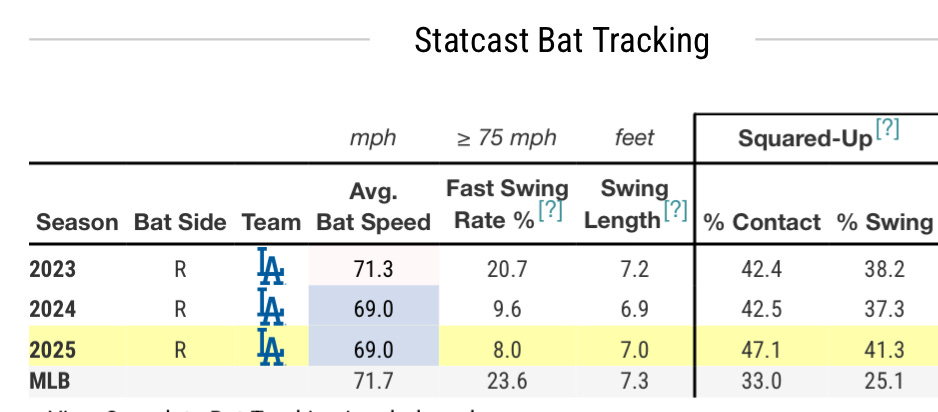
Last year was Betts’ age-32 season, which is when the bat speed aging curve really tails downward. His sprint speed has sat below league average since ‘23, and clocked at just 36th percentile last year. The Dodgers certainly don’t need him to run wild on the bases.
This is a soft fade; he’s one of a handful of oldsters you’d give short odds to beat projections. He should rack up 200-plus combined runs and RBI. The average should rebound to the .260 range. But the underlying trendlines tell us those “shoulds” are better framed as “maybes” for 2026.
***
Two 2B
Luke Keaschall ($10)
ADP: 147 | H99 - hADP 85 = -14
Jackson Holliday ($3)
ADP 140 | H155 - hADP 80 = -75
Being a half-round overvalued doesn’t make Keaschall an obviously terrible pick. He made a strong minor league statistical case, walking as much as he struck out in AAA, posting plus OBPs and wRC+s at every level, and swiping bags at a prolific rate. He was on a 40-steal pace in his short majors sample. However, the power is a question as no projection sees more than 13-14 dingers. The Twins offense may be bottom 10 in baseball. Keaschall has also missed lot of time to injuries, which seems like a basic prerequisite to playing for this organization. Briefly: torn UCL leading to TJS in ‘24; broken forearm on HBP in April ‘25; torn thumb ligament ended his season in September ‘25 (while stealing a base, which his drafters presumably hope he does often).
Here’s the main driver for our fade: we can draft almost the exact same projection and profile in Bryson Stott, who goes almost 50 picks later. Stott’s .255/13 HR/25 SB composite projection is nearly Keaschall’s mirror image. Yes, Stott will get subbed out versus some lefties and may bat lower in his order, but he’s been far more durable and his Phillies brethren are more potent than Keaschall’s fellow Twins. Otto Lopez goes even later (~200 ADP) and while unlikely to steal 30, he provides a proven, balanced stat profile. Heck, Andres Gimenez is projected for 11 homers and 21 steals and he’s buried in drafts. Matt McLain, Luis Garcia Jr…. there’s a bunch of 15/20 potential keystone players after pick 200.
Holliday also suffers from comps to a bevy of similarly projected players. Edit: Turns out he needs hamate surgery and will likely miss opening day. I wrote him up prior to that news dropping so we’ll keep it. Obviously the hand injury impacts the probability of power growth many were banking on:
He just doesn’t leap off the statistical page on an actual or projected basis. Even before the injury, It seemed inconceivable to purposely draft a 15/15 bat in round 10. The pick depends on pure faith: elite prospect with bloodlines presaging a power boost. But put away the goat intestines and Upsalla divination mushrooms for a moment: the kid is 22 coming off an 88.8 EV and 7.8% barrel%. Those metrics are below average and actually went down from ‘24. Part of Holliday’s 1.1 prospect rank came from the belief he was a legit shortstop defender (he’s not). His current game power grade just last year was 40, where 45 is average. Remember, we heard last offseason that he’d gained “12 pounds of muscle” to be able to swing faster (it was just 12 lbs. total but these physical impossibilities never get translated correctly). Let’s go back to bat speed:
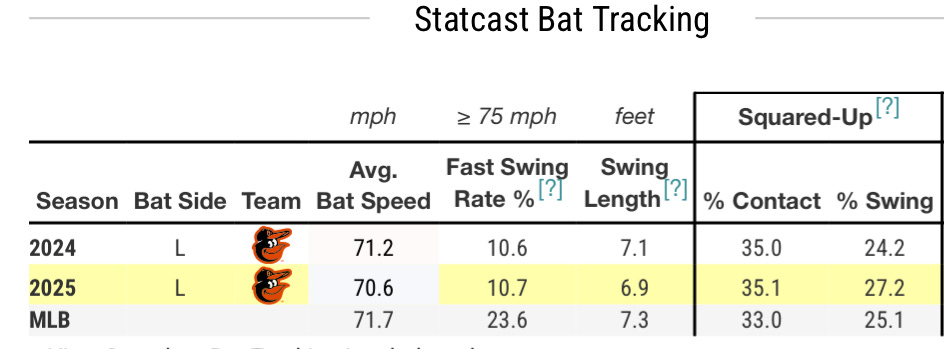
It also went down! (So maybe pump the brakes on big power boosts for Frelick, Teel, and others who boast 10-30 lbs. gains this Spring). And the fast swing% stayed the same. I don’t even like Matt McLain this year, but in a dreadful season he matched Holliday’s hard contact, and McLain flashed a plus 10.8% barrel% when he broke out in ‘23. Yet he goes 100 picks later.
We get it, the keystone is gross, Holliday has the name and potential and Roster Resource says he’s leading off. He might, but recall the O’s were totally out of the playoff mix by June, so they just let Holliday go, and of course they made a few FA additions to better compete in ‘26. Holliday held a .263 OBP and 62 wRC+ versus fellow lefties last year—and that was an improvement. And it’s not like he’s so well established that he can withstand a slump versus righties and remain at leadoff even against them. This year’s Orioles have options (Gunnar, Ward, a rejuvenated Adley could bat first). We didn’t hate Holliday as a breakout pick, but it’s a thin statistical case and far more likely you’re going “$%&!” in June because you passed on a more legitimate, projectable 10th rounder.
***
Alex Bregman - 3B ($10)
ADP 121 | H93 - hADP 70 = -23
We wrote about Bregman being overvalued back on January 22 (January Baseball Odds & Sods). TLDR: He bears some striking and unflattering comparisons to Arenado; Wrigley could be trouble for his power; potentially better real life than fantasy asset (at least at this price). Give me Matt Chapman 40 picks later.
***
Eugenio Suarez - 3B ($9)
ADP 124 | H103 - hADP 72 = -31
Geno rocks beautiful flowing lettuce and we know what to expect with the stick: lots of bombs, no steals, and a wretched batting average. In a way he resembles Chandler Simpson in that his selection might be a resignation that the team we’re building may be unbalanced and needs to solve a categorical deficiency in one fell swoop. The average is almost guaranteed to be a killer (.218 projection per Bat X) and while 30 homers seems like a lock, he did manage only 22 as recently as ‘23. That was in a full 162-games played season, although to be fair that was in Seattle. He’s also extremely streaky, from nearly being DFA’d by the D’Backs (and fantasy owners) halfway through ‘24, to blasting 51 homers with a .390 wOBA from that ASB to the ‘25 ASB, to cratering in the second half of ‘25 following the trade back to Seattle.
Yes, now he’s in Cincinnati and that tiny park. Suarez has also been durable, which usually leads to solid runs and RBI production. But his on-base skills have taken a noteworthy hit recently: over the last two seasons he’s at a 7.3% BB% and .308 OBP, both below average. So it’s definitely a bad batting average with hellacious valleys and even some uncertainty about the category you’re drafting him to carry. This sounds a lot like Munetaka Murakami, a 3B drafted seven rounds later (who should walk more and also swipe 7-10 bases).
***
Noelvi Marte - 3B/OF ($8)
ADP 146 | H110 - hADP 84 = -26
Marte’s shown flashes of enticing power and speed in the past, plays in a great park, and qualifies at two positions. But as with Holliday, the upside/risk calculus just doesn’t scan in the top 150. Do people think he’s going to steal 30 bags?
Noelvi also ticks another box: players who make their actual managers cry, “%#*!” Leave aside the half-season PED suspension. Francona held him out of a playoff game against the Dodgers and Marte earned a grand total of four plate appearances in that two-game series. As this spring training kicked off, Tito said he wanted a righty batting in the two hole and first thought of Marte but “he struggles against lefties.” Indeed, since he entered the majors Noelvi has a feckless .595 OPS vs southpaws. He’s also hit for better power and average on the road despite the most homer-friendly venue in the majors. He’s a tough dude to figure out.
Call me crazy but Marte is a wild card with a short leash and a manager who didn’t even let ace student Elly run free last year (or anyone else. In 2024 David Bell’s Reds tried stealing second 52% more than league average while Francona’s ‘25 squad sat 15% below). Cincy has the sport’s best defensive 3B in Hayes plus corner guys Stewart and Steer and others with names that don’t begin “St-“ who can demand PT. There’s no guarantee Marte plays every day or has the green light on the bases. Yes, he’s 3B/OF eligible but so is Miguel Andujar. Noelvi’s going way too high.
***
Sal Frelick - OF ($1)
ADP 201 | H168 - hADP 123 = -45
If you believe Sal Frelick gets to double digit dongs again, be my guest. He had a 3% barrel% and 27% Hard-Hit%. No thanks. Give me a similarly priced Daylen Lile every time. Hell, I’ll even take Darlene Lile instead (as my spellcheck wants to dub him).
***
Jose Caballero - 2B/SS/3B/OF (-$3)
ADP 220 | H212 - hADP 135 = -77
To be fair, this is based on a 327 PA projection and presumptive starter Anthony Volpe won’t be ready to return “at least until May.”
If we imagine Volpe returns in July instead of the planned date and give Cabby 450 PA, he becomes a projection value because the steals go up to 43. But I don’t care if he’s eligible at 43 positions to boot, the rate batting average of .219 says you don’t want to have this bat in your fantasy lineup every day. Besides, having to Frankenstein batting average and power—the increased PA results in 9 total HR—using other imbalanced players is not a tradeoff we want to make. And Volpe will get a shot to start when he’s ready. Despite being drafted as a starter even in 12-team leagues, Cabby is best used as a bench or even waiver piece to drop into lineups occasionally and rack up steals for fantasy teams that need them. In other words, exactly what he’s been his entire career to this point. Perhaps his drafters’ approach is to front load that advantage, but we can’t bring ourselves to rely on what amounts to such a fragile, single-path strategy.
Your correspondent is not enthralled by the AI boom’s endless possibilities. Earlier this week, Matt Shumer, an entrepreneur in the space, wrote a sobering essay on X that has 77 million views. He explained that because its engineers taught AI how to code, it now has a key role in reprogramming itself, which has caused the technology to grow faster than any casual observer likely knows. This increases risks to human jobs at a galloping pace. The risks go beyond jobs, including perhaps control of the tech itself; because they can code, the latest top end AI agents can learn anything they’re trained on, and more quickly. They display judgment and can open and iterate any task on a computer. See below for a link to a recent NY Mag interview Shumer just gave about the essay.
Unfortunately, in my view, Shumer’s shortcoming was the sum total advice to get on the train before it runs you over. He assumes the tech’s inevitability, failing to reckon with the power held by a select few men who are driving the boom with profit as the only hard incentive. We would have liked to see a call for wide-ranging AI regulation. It took hundreds of people biting into glass in their peanut butter or maggots in their sandwiches and the like, followed by years of product liability litigation, before we truly regulated food safety in a comprehensive manner. That was in the 1930s. The AI challenge won’t allow for that pace. Of course, due to 32.6% of eligible adults’ decisions in 2024 (fewer people than have viewed Shumer’s X post), federal regulation generally has hit the skids in the last 13 months—DoJ recently axed its chief antitrust attorney, the Consumer Financial Protection Bureau gutted, etc.—but we would argue that the stakes presented by failing to implement an AI regulatory framework are infinitely higher than even food or product safety.
Essay:

Interview: https://nymag.com/intelligencer/article/viral-ai-post-anthropic-chatgpt.html